Double-checking My Planned but Minimal Battery Upgrade

(it's worth noting-- "danger is real; fear is not real"-- that they used a Nissan Leaf battery, not exactly a marine LifePO4 ABYC blah blah, and who knows where all their solar and regulators and temperature sensors and BMS and wiring and all the rest came from, was installed by, etc..)
 
I think that the Li-ion has much lower resistance than a LiFePo4 battery, that allowed them to accept a charge much faster but also more prone to catch on fire. That is why a LiFePo4 is a must in a boat.
I’m not an electrical engineer but I did a bit of research and feel safe with those on my boat.
 
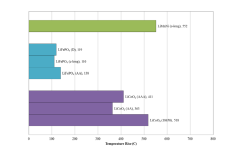
Sorry to throw "water" on your Li fire... but LiFePO4 batteries are quite safe. That is why most of us recommend that this is the only Li chemistry one should use on a boat. They don't have the energy density of Li ion or LiPo batteries but are much safer. Here is a graph of research done by the Federal Aviation Agency on the internal temperature when a Li battery goes into thermal runaway (i.e. internal short). Note that LiFePO4 is around 100 C. Well below the combustion temperature of most materials. Combustion temperature of paper is around 400 C and that of many plastics start at 350C.

1776113506874.png
 
The video on fire is certainly though provoking, and we all have some of the devices which have the more "dangerous" type of Li ion battery in our phones, camera batteries etc. Also good advice to consult with more knowledgeable people on design and protection of the Li battery systems. The one item mentioned which was mentioned, I don't see emphasized enough, is battery temperature, especially if in an enclosed space. Unfortunately in our C Dorys there are not a lot of alternative escape routes.

We had Personal locator beacons for each of our watch standers: The PLB, a strobe and a handheld VHF radio were all fixed to the inflatable life jacket and safety harness. We also had a separate PLB in each of two ditch bags. One was by the helm, and the second ditch bag was placed with the inflatable. The person on watch was susposed to keep the ditch bag close at hand at all times. We also kept the hard dinghy filled with fenders, and `10 gallons of water and there were two other five gallon water containers by our inflatable dinghy just in front of the Main Mast. There was a second EPRIB packed. with the inflatable. Our EPIRB was located by the companionway-- and I would still place it there.

While at sea we had a daily contact via ham radio with my father, who lived in Liesure World and had access to a great setup with good beam antenna and a 2 KW amplifier if necessary. (We had a 600 watt 12 volt amplifier. And we checked in with one or more of the maritime mobile nets daily.) We didn't have a formal "float plan", although that is probably a good idea. We also had a HF marine radio, and checked in with Coast Guard Miami or similar radio stations on HF if there was a security issue. (Like a CG cutter comming up dark in international waters.)

For firefighting, we had a fixed system in the engine room, and a number of portable extinguishers around the boat. Also there were plans for each kind of emergencies which each new crew number was required to read and memorize.

 
Sorry to throw "water" on your Li fire... but LiFePO4 batteries are quite safe. That is why most of us recommend that this is the only Li chemistry one should use on a boat. They don't have the energy density of Li ion or LiPo batteries but are much safer. Here is a graph of research done by the Federal Aviation Agency on the internal temperature when a Li battery goes into thermal runaway (i.e. internal short). Note that LiFePO4 is around 100 C. Well below the combustion temperature of most materials. Combustion temperature of paper is around 400 C and that of many plastics start at 350C.

View attachment 130317
Great stuff, Tom. Adding to this for the forum (not for you, who knows this) is a succinct and helpful video by Will Prowse on the matter, corroborating the FAA chart and showing the potential failure points (and their minimal risk despite them, provided you’re still cautious as it’s a battery just the same):


I feel much better about all of this now. Phew!
 
Thanks for sharing this video, I felt good about my LiFePo4 but now I fell even better.
 
Back
Top