How concerned should I be?

Timporal

New member
Joined
Apr 16, 2026
Messages
5
Reaction score
2
Location
Anchorage
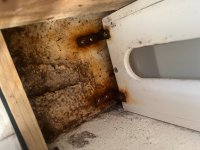
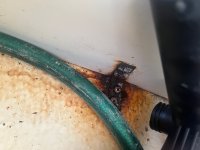
Hi team, I'm looking at purchasing an '05 25 in Alaska. There are a couple red flags that I would love to get your thoughts on. This will be my first C-Dory and first boat.
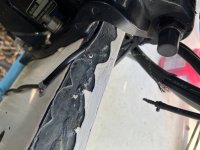
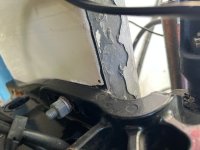
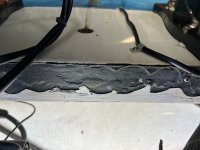
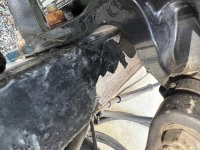
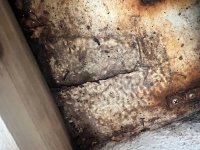
The fiberglass on the transom is chipped away, and some sort of black substance has been applied to seal it. I'm including pics of a couple other problem areas below the sink in the cabin.
How concerned should I be about this? thoughts on how to look/test for bigger issues I'm having someone get a moisture meter on the transom tomorrow.

Thanks for your thoughts!
 

Attachments

  • IMG_6517.jpeg
    IMG_6517.jpeg
    1.7 MB · Views: 22
  • IMG_6516.jpeg
    IMG_6516.jpeg
    1.6 MB · Views: 22
  • IMG_6515.jpeg
    IMG_6515.jpeg
    1.8 MB · Views: 22
  • IMG_6514.jpeg
    IMG_6514.jpeg
    1.8 MB · Views: 21
  • IMG_6506.jpeg
    IMG_6506.jpeg
    1.5 MB · Views: 21
  • IMG_6503.jpeg
    IMG_6503.jpeg
    2.1 MB · Views: 20
If someone did a repair job that sloppy it's safe to assume the top of the transom was compromised and moisture got inside and it's now trapped, which means rot. Click on my icon to the left and then click on the number 91 under "Media" to see what I went through to repair the sloppy repair job someone did on the top of my transom. If you click on each photo, you can see commentary on the right. So yes, you should be concerned, but it is also something you can repair. There are posts in this forum of much worse transom damage that owners have repaired themselves.

As for the areas under the sink, the floor on these boats, from the forward bulkhead back to the transom, is balsa core. Any penetration (i.e. screw holes) allows water to get into the balsa and subsequently cause rot. The seriousness of the issue and the repair required ranges from minor to very major. If you search on the forum for "balsa" you will get lots of hits and can read how owners have dealt with this. I would be concerned.
 
Last edited:
It is hard to know what the real extent of damage is, but you shoud be doing moisture readings on the bottom of the hull (hoping the boat is on a trailer), on the transom, and the cockpit floor. The area under the tanks which are now 21+ year also has a history of rot, and if the tank has been leaking, there may be damage on the inside of the actual hull layer. Both moisture meter and sounding with a phenolic hammer, bsck of screwdriver etc, will give a lot of information. Is there a marine surveyor near by?

Even though his books are somewhat controversial, I suggest buying and reading David Pascoe. "Surveying Fiberglass Power Boats". You should read and reread the section on moisture meters. There are some articles on the use of a moisture meter by Pascoe before you get the book. One factor in the negative for a boat in Alaska, is the number of freeze / thaw cycles in Alaska, the boat has gone thru, may give you some good ideas if you want to take on what might be a serious project and repair. If you decide to move forward with a project, there are plently of C Brats to help you!

With that work done, an depending on what you find with the moisture meter in the cabin, around the aft cabin bulkhead the transom, cockpit floor, and bottom of the boat inside and outside. I would be offering on the lower end of prices to buy that boat.
 
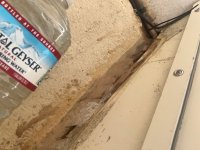
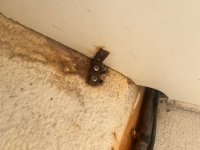
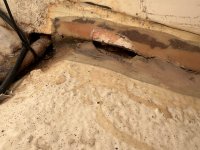
Thank you both for your thoughts! I'm including a few more pics of questionable areas and rusty hardware in the cabin. Is rusty hardware like this just part of the marine environment (and should have been SS to begin with) or is this a sign of something more troubling? I know all boats are projects, but I'm honestly not trying to get into major project boat territory for at least the first 1-2 years 😅

A marine surveyor already did a valuation survey, and stated:
-"Hull port and starboard side was tested with a moisture meter and low readings found".
-"Transom was moisture tested and elevated levels were found. Transom has over 20 holes drilled by factory to install trim tabs, engines, depth sounder, drains, and other equipment. It is not uncommon to have moisture in the transom. The transom was also percussion tested and only slight variations were found that were too suttle to specifically state that the transom was delaminated. The transom has been repaired previously and should be recoated".

I'm having a different surveyor come out with me tomorrow. Unfortunately, it's been dumping for a week here, so I'm not sure how accurately we'll be able to do any moisture metering.
 

Attachments

  • IMG_6501.jpeg
    IMG_6501.jpeg
    1.9 MB · Views: 5
  • IMG_6504.jpeg
    IMG_6504.jpeg
    1.8 MB · Views: 5
  • IMG_6505.jpeg
    IMG_6505.jpeg
    1.7 MB · Views: 5
  • IMG_6509.jpeg
    IMG_6509.jpeg
    1.6 MB · Views: 5
The "L" brackets were "zinc" or "Cadmium" coated stardard from the factory. This boat most likely has been in a high salt environment all of its life. I have approached these problems, but removing the "L" brackets, and putting a coupld of inches of fiberglass tabbing. I use mat which is compatable with epoxy resin, and cloth also compatable with epoxy. The binders in some glass cloth mat/woven and roving are soluable in polyester resin, but not epoxy. You want to repair these with epoxy resin because of considerably better adherence to the already cured polyester resin. The old glass tabbing (that which appears broken in #6504) should be all ground off, and down to some solid glass. I assume this is the bulkhead between the Cabin and cockpit by the hull. There is no real structural failure, but if it fully breaks down, then it would be an issue. I would replace all of the cockppit deck (floor) hatches, with water proof ones--there are a number of threads on this, and the proper IMETRA hatchs to use. Then all balsa is cut out, undercut around the hatch opening, and fill this will thickened epxoy. Any place there seems to be delamination, should be replaced. This is long term care/cure. I would do a bit more on the transom--over drill each of these openings, and then completey fill with thickened epoxy. Any place a screw penetrates the deck. should have a better core and the screw is biting into thickened epoxy. Try and keep penetrations in the transom to a minimum. The current outboard should be removed, and then the hole where the bolt was, undercut and filled with the thickened epoxy. Also put all of your weight on the lower unit, with outboard in trailering position. I also put extra roving and mat on the inside of the transom. The plywood core of the transom does not go out within a few inches of the transom and hull position.

I would use the boat this season and then spend a portion of the winter with the boat stored indoors, with climate control and area for a workshop. Take the floor out around the outside margins of the fuel tank. Pull the tank, clean it, and determine how much pitting is present. I would probably put a new tank in, unless there is basically no corrosion. Check the hull inner surface of the hull for intregrity of the core and delamination. Completly remove the tabbing of the aft cabin bulkhead on forward and aft sides, replace tabbing with two layers of mat and cloth or 1708 material. Pull all "L" and fill the screw hole (over drilled) with thickened epoxy. The put in 2" tabing where each of the "L" brackets were attatched--again sand down well. Check the rub rail for leaks, and replace any compromised fasteners. Check the V berth tabbing and the bulkhead between the main cabin and V berth cabin. Then you will have a solid boat for many years.

Any questions please ask and one ir more of the C brats will answer the questions and guide you through the repairs. Our boats are not more susceptible to blistering, core rot or delamination than any other boats. However our C Dorys have kept their value and in some cases appreciated in value. Unusual in the boationg world, and a testimony to how beloved and practical the boats are. I first saw a C Dory in 1982, and made a vow to buy one of these when I got too old and decrepit to sail. I honored that pledge in the early 2000 eras--and owned 5 C Dorys until I felt I could no longer care for the boats and cruise in them in my late 80's. I will be 90 in about a month.

 
Back
Top