Basic Electrical

Donald Tyson

Member
Joined
Jul 24, 2023
Messages
695
Reaction score
11
On my boat I have two starter batteries and two house batteries. Then I have the main switches and panel below the helm seat. On the front dash is another panel. Under the sink is a charger and a nice looking inverter. When I get to the boat tonight I will turn on the inverter power switch in the main battery box to starboard. Then when ready to go out onto the bay I flip the starting batteries on, start the engines and off I go.

When in the slip I have the boat plugged in with a 110 cord to the pedestal on the dock... that is how it works at this marina.
It seems that if I turn on the main switches the dock power blows the fuse. Is that the correct thing. Then I turn off the mains switch and reset the dock and all is back to normal it seems.

Is that dock power also charging the house batteries?

The other night I ran a ceramic heater and the Fridge at the same time and the batteries died in a little over two hours.

I have little understanding of electrical but it seems that if the boat was plugged into the dock per and circuits were open that the fridge and heater would have run indefinitely until I unplug from the dock. It seems like the solar panel will keep up the batteries fine when I'm out on the water as long as I keep the fridge power on low. So I know the panel is doing its job.

There seems to be this issue about having the main switches on under the seat, that they will kick the brakers on the dock.

More to come. This is the first boat I've owned with more than a starting battery and also the first to have dock power. I'd like to state how I hate Electricity but that would be silly, knowing how important it is to surviving heat and cold, and also storing food. Another problem I have is that I'm simply too fat to get at the places where all these connections and components are. Beyond flipping switches I find myself very dependent on costly professionals.
 
There is a new standard for dock electrical systems regarding ground-fault protection. These can be very sensitive. The electrical systems on older boats often have problems with the newer dock pedestals.
 
I had trouble with tripping breakers on the dock also. It worked fine at my older marina but did not work with modem GFIC circuits. My problem was the original shore power wiring had the ground and neutral bonded in the box on the boat. It was an easy fix to isolate them but it took a bit with my layman’s understanding to figure it out.
 
Your description of your wiring system suggests it is quite complicated. From experience I know that I need to have my shore power input completely separate from my batteries and inverter. A separate switch is needed that powers my 120 V internal system either from the shore power or the inverter. If charging either house or starting batteries from shore power the charger(s) also need to be on a separate circuit with their own circuit breaker. This should always be turned off when charging from solar or the motors. These days shore power circuits on boats also need to have a galvanic isolator (new regs). The shore power circuit installed by NMI on my 2024 boat goes first to the isolator and then to my 120 V circuit breakers (30A entire system, 15A 12V charger, 15 A cabin plugs, 15A 48V battery charger). When running my 48V inverter to my 120V system I have to disconnect my shore power circuit.
 
P.S. Any 120V appliance that is based on resistance, like a space heater or hot pot, will drain your battery very quickly. You can do the math to figure out how long the battery will last. A 1500 Watt little space heater will use 1500 Wh or 1.5 kWh of electricity per hour. A 12V 100AH battery only holds 12V x 100AH = 1.2 kWh of energy. Your inverter is also not 100% efficient so your space heater may only run about 30 - 40 minutes on a fully charged 12 V battery.
 
From experience I know that I need to have my shore power input completely separate from my batteries and inverter. A separate switch is needed that powers my 120 V internal system either from the shore power or the inverter. If charging either house or starting batteries from shore power the charger(s) also need to be on a separate circuit with their own circuit breaker. This should always be turned off when charging from solar or the motors. These days shore power circuits on boats also need to have a galvanic isolator (new regs). The shore power circuit installed by NMI on my 2024 boat goes first to the isolator and then to my 120 V circuit breakers (30A entire system, 15A 12V charger, 15 A cabin plugs, 15A 48V battery charger). When running my 48V inverter to my 120V system I have to disconnect my shore power circuit.
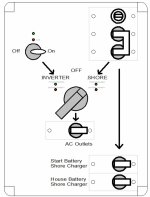
Here's a diagram of the AC control panel I'm building for my '99 restoration. It shows conceptually exactly what Tom is talking about.

The upper right double breaker is where shore power comes in. Unlike home electrical panels, both hot and neutral have a breaker. This is because some sloppy shore power panels can be wired backwards.

As Tom mentioned above, the ground wire that comes in with the shore power should be passed through a galvanic isolator first. Also, ground should only ever be bonded to neutral in one location. Assuming it's grounded to neutral at the shore panel on the dock (as code requires), it should NOT be grounded to neutral anywhere on the boat when you are connected to shore power. That's why the inverter must be disconnected from the circuit when shore power is being used. Ground IS bonded to neutral at the inverter because when using the inverter you should not be connected to shore power, and thus the one ground to neutral bond is provided by the inverter. Also, if you choose to use an onboard generator as "shore" power, then ground must be bonded to neutral at the generator to provide that one bond.

Re. your GFI tripping, some inverters have internal transfer switches that will disconnect themselves from the circuitry when they sense that shore power is present. The problem with this solution is that, unlike the physical switch at the center of the control panel I’ve shown, there is a small delay before the shore power is detected and when the inverter disconnects itself. During this time ground is now bonded to neutral at two locations, and leakage current can flow though ground and cause ELFIs and GFIs to trip. I suspect this is what is happening with your setup. The solution (if you’re not willing to live with the current arrangement) is to provide a means of removing that inverter from the circuit before you switch to shore power. It doesn’t need to be turned off (the inverter switch I’ve shown is just for convenience), just disconnected from the AC circuitry. The Blue Seas 9009 switch I'm using to do this is a break-before-make switch. This means as I manually turn it from Inverter to Shore, the AC circuitry (outlets) is momentarily connected to nothing, and the inverter and shore power are never for a moment both connected to the AC outlets. I would have a marine electrician look into this if you want to make changes. Inverters can be deadly and aren’t to be messed with if you’re not on good terms with electricity. 😊
 

Attachments

  • Untitled.jpg
    Untitled.jpg
    70.5 KB · Views: 1
Last edited:
Is that dock power also charging the house batteries?

The other night I ran a ceramic heater and the Fridge at the same time and the batteries died in a little over two hours.
I don't know how your boat is wired and without a schematic no one is going to be able to give you a definitive answer. The situation you describe shouldn't occur though if things are wired properly. The dock power should easily be able run a heater and refrigerator and still charge batteries at the same time.

The ceramic heater should be plugged into an outlet that is powered by shore power when you are plugged into shore power and by the inverter when you are not. Same goes for the refrigerator if it is 120VAC only, although it draws substantially less power than the heater. Ideally it's a two-way refrigerator that runs off either 120VAC or 12VDC. A two-way refrigerator should be plugged into an AC outlet that is a shore power only outlet. You don't want to waste energy running an inverter to make 120VAC for the refrigerator when it can be run off 12V.
 
I had trouble with tripping breakers on the dock also. It worked fine at my older marina but did not work with modem GFIC circuits. My problem was the original shore power wiring had the ground and neutral bonded in the box on the boat. It was an easy fix to isolate them but it took a bit with my layman’s understanding to figure it out.
I can almost grasp that. Seen that in a house or something once where neutral and ground were bonded.
 
Here's a diagram of the AC control panel I'm building for my '99 restoration. It shows conceptually exactly what Tom is talking about.

The upper right double breaker is where shore power comes in. Unlike home electrical panels, both hot and neutral have a breaker. This is because some sloppy shore power panels can be wired backwards.

As Tom mentioned above, the ground wire that comes in with the shore power should be passed through a galvanic isolator first. Also, ground should only ever be bonded to neutral in one location. Assuming it's grounded to neutral at the shore panel on the dock (as code requires), it should NOT be grounded to neutral anywhere on the boat when you are connected to shore power. That's why the inverter must be disconnected from the circuit when shore power is being used. Ground IS bonded to neutral at the inverter because when using the inverter you should not be connected to shore power, and thus the one ground to neutral bond is provided by the inverter. Also, if you choose to use an onboard generator as "shore" power, then ground must be bonded to neutral at the generator to provide that one bond.

Re. your GFI tripping, some inverters have internal transfer switches that will disconnect themselves from the circuitry when they sense that shore power is present. The problem with this solution is that, unlike the physical switch at the center of the control panel I’ve shown, there is a small delay before the shore power is detected and when the inverter disconnects itself. During this time ground is now bonded to neutral at two locations, and leakage current can flow though ground and cause ELFIs and GFIs to trip. I suspect this is what is happening with your setup. The solution (if you’re not willing to live with the current arrangement) is to provide a means of removing that inverter from the circuit before you switch to shore power. It doesn’t need to be turned off (the inverter switch I’ve shown is just for convenience), just disconnected from the AC circuitry. The Blue Seas 9009 switch I'm using to do this is a break-before-make switch. This means as I manually turn it from Inverter to Shore, the AC circuitry (outlets) is momentarily connected to nothing, and the inverter and shore power are never for a moment both connected to the AC outlets. I would have a marine electrician look into this if you want to make changes. Inverters can be deadly and aren’t to be messed with if you’re not on good terms with electricity. 😊
Good explanation and I’ve decided I’ll hire a marine electrician at a flat rate to point out what I have.
 
So is the inverters only job to convert the 12v from the house batteries into 120 for the fridge ? I’m on the boat right now so I’ll try it with no inverter. Thanks
 
Back
Top