22 Bridge Clearance / Air Draft on Water with Various Roof Mounts

DaveInRI

Member
Joined
Aug 5, 2024
Messages
92
Reaction score
4
Location
Barrington, RI
C Dory Year
2005
C Dory Model
22 Cruiser
Hull Identification Number
CDO22275K405
While I wait for the 36” of snow from last week’s storm to melt, and my new-to-me bare bones 22 is wrapped in the backyard, I am reading about various low weight uses for the roof: radar arches and masts (folding and not), fender storage, dinghy storage (inflated and not), kayaks, cargo racks, nets, etc..

While I understand on-water bridge clearance changes with load-out (and even salinity if you’re picky), I’m just looking for a general starting point for my scheming. I do have a 10’ bridge (4.5’ tide) to contend with each time I go out and want to be respectful of that in said scheming. (I actually lucked out as they demolished a 5’ clearance bridge so now I can hopefully stay non-tidal forever— that’s the real goal, come and go any time of day).

I’ll measure my own boat in spring, but for now am curious if any 22 owners know their general air drafts with things like radar masts or arches high enough for dinghy tubes to slide under, cockpit enclosure step-ups, etc.. Any VHF antenna will have to fold, that much I already contend with (I take mine off at higher tides as it’s not a foldable one yet). I also aspire to do the Lachine canal in Montreal which is 8’ clearance IIRC, and so having hardware relatively easy to lower is preferred over something more semi-permanent like de-masting a sailboat for a canal journey (sure you can do it, but…). And yes, I know I can outfit differently on the more adventurous trips and when trailering to new waters (also aware of 13.5’ road clearance).

I did search the forum but wasn’t able to find the info for a 22 beyond “we went under the bridge” examples that didn’t necessarily say what was on the roof. Most of the posts were for the 25 and TomCat, so this new thread might be helpful for other newbies, also.

I’m particularly interested in heights at max and then, if folding, the heights at minimum without full removal. If not folding, just heights then.

My boat is a 2005 with standard roof height, not the high top.

Thank you.
 
Hi Dave,
Give yourselves some trips under your belt before spending too much. If you don’t have a dog, you may not need a dinghy. If you beach on rocks, you may not want an inflatable (we just gave ours to the Boy Scouts, after never feeling a need for it in real life after 13 years). Raise the outboard and you float in calf deep water…who needs a dinghy if you have Crocs and adventurous kids?

Antennas don’t fold, but are screwed into ratchet mounts that mount to either your boat roof (remember every roof penetration is a future leak) or to a roof railing (my preference). Your eyeballs won’t be at six feet over the water on your boat, but even if they were, a boat three miles away won’t be visible due to the curvature of the earth, and you don’t care about anything that far away. The few exceptions include the 50 MPH Halifax ferry and the 30 MPH PNW ferries; there are exceptions to every rule). So, no need for antennas that are so high they make your boat tip over.

I’m not convinced that radar is all that mandatory on our boats. If fog is present or predicted, don’t go. A radar decent enough to be truly useful might be 24”, which would make your boat look odd. Again, just anchor in knee deep water and wait for it to pass, knowing that FOR SURE, you will not be run over by a 70 foot Viking or a towboat pushing a 40- barge string in your knee deep water. AND, I contend that a Rx/Tx AIS (old Class B if fine if you cruise under 20 MPH) is way more useful, in that only AIS and not radar ID’s your targets BY VESSEL NAME so you can initiate early radio comm with them.

A 100w solar panel like my Renogy would take up way too much roof space , and be shadowed by radar and all your other stuff. A 2000w (1700w running) generator provides the same power as a typical household outlet, which runs in clouds, rain and darkness. I’m generally not impressed by Harbor Freight stuff, but I was shocked that Consumer Reports (whose testing I DO respect) rated the Predator 2000w inverter generator ($650) as good as the Honda 2000iu ($1,200). Get the HF warranty and you’re covered.

Have fun planning!
John
 
Hi Dave,
Give yourselves some trips under your belt before spending too much. If you don’t have a dog, you may not need a dinghy. If you beach on rocks, you may not want an inflatable (we just gave ours to the Boy Scouts, after never feeling a need for it in real life after 13 years). Raise the outboard and you float in calf deep water…who needs a dinghy if you have Crocs and adventurous kids?

Antennas don’t fold, but are screwed into ratchet mounts that mount to either your boat roof (remember every roof penetration is a future leak) or to a roof railing (my preference). Your eyeballs won’t be at six feet over the water on your boat, but even if they were, a boat three miles away won’t be visible due to the curvature of the earth, and you don’t care about anything that far away. The few exceptions include the 50 MPH Halifax ferry and the 30 MPH PNW ferries; there are exceptions to every rule). So, no need for antennas that are so high they make your boat tip over.

I’m not convinced that radar is all that mandatory on our boats. If fog is present or predicted, don’t go. A radar decent enough to be truly useful might be 24”, which would make your boat look odd. Again, just anchor in knee deep water and wait for it to pass, knowing that FOR SURE, you will not be run over by a 70 foot Viking or a towboat pushing a 40- barge string in your knee deep water. AND, I contend that a Rx/Tx AIS (old Class B if fine if you cruise under 20 MPH) is way more useful, in that only AIS and not radar ID’s your targets BY VESSEL NAME so you can initiate early radio comm with them.

A 100w solar panel like my Renogy would take up way too much roof space , and be shadowed by radar and all your other stuff. A 2000w (1700w running) generator provides the same power as a typical household outlet, which runs in clouds, rain and darkness. I’m generally not impressed by Harbor Freight stuff, but I was shocked that Consumer Reports (whose testing I DO respect) rated the Predator 2000w inverter generator ($650) as good as the Honda 2000iu ($1,200). Get the HF warranty and you’re covered.

Have fun planning!
John
Thanks, John. Appreciate it.

A fair amount of our boating this season will be in Downeast Maine near Acadia and Camden etc, home of 11’ tides, sometimes daily fog until late morning all summer, and lots of rocks (and 63 degree water). We do have a dog, and adventurous kids, both needing to get ashore, but we can’t carry the mothership back to water if we misjudge the tide or get held up by kids; a bit easier with a lightweight inflatable. And around our home base, it’s mostly transient moorings without launches, or very expensive slips ($120 a night for one I checked recently on the Cape), so I actually think it’ll pay for itself using “boat math.” I believe the best part is no part, but can’t find an easy way out of this for where we are and want to go.


The radar I think I could get by without, but wanted to know heights of the arches and masts to see if they’d push me over my own personal height limits; makes it an easier decision and one less thing to learn all I can about until I someday have a boat with radar. I’d be more pleased with its daytime use than fog, as I can always sit out the fog like you said, but even with my head on a swivel I’m still surprise-passed by channel cutters and day drinkers here in busy RI.

All that said, I’m still hoping to learn the bridge clearance heights of a 22 with radar mast or arch in their up and folded down (if applicable) position, preferably without my looking up specific models just yet.

Always happy planning…
 
The Raymarine 24" radar does not look out of place on a C Dory22 where as a 4' open scanner would. The dinghy serves all sorts of other uses than just taking a dog ashore. We have used ours in several emergencies to get people out of the water, to get an emergency message out at Lake Powell, to get. the daily newspaper (Wall Street Journal) downloaded or to make cell phone contact.

A dinghy can be your life raft. It can be used to explore places where you might not be able to take your 22, and those do exist in SE AK, on the St. John's River to name a couple we have used, also in BC. If you are going onto sharp rocks, there are harder materials which can protect the bottom of an inflatable, or extra layers laminated in place prophlactlly. I could go on. We all have different styles of Cruising, I would be bored to death sitting at the "Pink Pearl" for 3 months, vs exploring SE Alaska, taking some changes surfing calving glaciers, or encountering Grizly Bears.
 
Dave, Every boat is set up differently, (different arches, different placement with different accoutrements on top,) and those are only part of the equation. What you have in the boat, and where that is placed will also affect your air draught. Is it in the bow, or the cockpit? Those again will change the rake of the boat, affecting that vertical clearance. and the antenna type, length and placement, (for and aft, on the roof or on the arch, or the side wall {which I would highly NOT recommend} will add more variables.

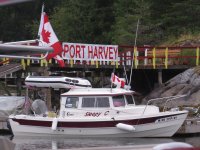
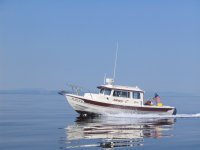
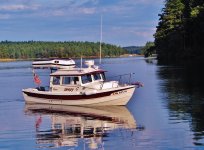
Sitting at the helm seat, my eyeballs are close to 3 feet above the water level. From what I remember from doing the Sacramento River Delta cruise, (only place where bridge clearance for me was close to an issue), IIRC, I was able to clear under an 11 foot bridge, with inches to spare, and without doing anything with my antennas. I have a single 8 ft, mounted on the roof, forward port corner, on a ratchet swivel. Sometimes it is adjusted to angle slightly forward, or straight up, depending on where I am and what my cruising speed will be, (if I will be up on plane, or slow cruising). I want it perpendicular to the water surface most generally. You can listen via you antenna if it is laying down, but I wouldn't recommend transmitting with it unless it is up in the vertical position. You could use a Marine Handheld VHF for monitoring and transmitting until you are past the bridge then raise your antenna.

As to my friend John's advice about the radar, I must respectfully disagree. I live and boat in the PNW, and fog here is not uncommon. We have a month here named FOGust, which if we waited out the wx for the change, You might not get to go at all. WE have many mornings that last until noon or later and there are times when it is thick enough that IF you were walking on the water, you wouldn't see your feet. I totally agree with him on the AIS. I have both radar and AIS, and with that combination, I am comfortable boating, if the wind and waves allow. There is a very high percentage of recreational (mostly smaller fishing (14 to 25 foot) vessels that do not have AIS or radar, but they still go out because they know where their fishing hole is. If you have radar, you can see them coming at you from any angle. That glimpse is worth the price of the radar for you to be able to avoid them. (NOTE: They will not avoid you!) That boat unit you spend for the radar will be far less expensive than the fix that happens if you don't avoid them.

Harvey
SleepyC
2016-06-30 2016 Sept Canon Pix  Vancouver Is 013.JPGJC Lately & SleepyC Flat Blue 070.jpg
 
Thanks, all. At the careful hope of not being dismissive of helpful people, I’m just wondering if anyone here knows off the top of their head their own bridge clearance for say a tall arch, a mast, a folding arch, low arch, etc., for me to say “oh ok that would work, I can add “pick radar” to my project list” or “ok I can’t have a tall arch and maintain bridge clearance at home; that means short arch, which means different dinghy transport needs” etc.. Sort of like a sudoku puzzle: I know my options are down to 4 numbers it could be, but want to use info from other boxes to narrow it further.

It sounds like that even with a high arch, I’d be under the 10’ bridge clearance on our home river, and potentially down below 8’, definitely so if it is a folding arch with service loop/slack in the tubes for wiring. This is encouraging as it means I can start learning what I need.

Our boat came bare bones, lightly used, and affordably priced. Adding an enclosure, new electronics, gauges, radar, etc., could easily add $10k to the boat’s cost but not to its resale (it’s like buying a house with a pool: might cost an extra $20k but to add a pool to a house without one is $100k), so I’m motivated to eliminate what wish list items I can while also maximizing learning opportunities to parlay into cruising aspirations for later life.

I’m also just bored after a long and cold winter, and a house remodel that started in September and has another month on the clock. Boats are distracting in a good way.

And I’m with Bob— I get bored going left or right, or marina to marina. I want to get away from people and houses and lights :)

Thanks everyone. Great group.
 
... I’m generally not impressed by Harbor Freight stuff, but I was shocked that Consumer Reports (whose testing I DO respect) rated the Predator 2000w inverter generator ($650) as good as the Honda 2000iu ($1,200). Get the HF warranty and you’re covered.
...
Harbor Freight has stepped up their game a lot in the last couple of years. They have a variety of different lines of products now. Some are pretty good.
 
Ok Dave lets fgure this out. But first youve got to ask and answer some questions for yourself. But before we do all that I'll give you the short answer based on what I know. I know youve stated you want to go under a bridge that measures 10' clearance at a 4.5' tide. I know you mentioned going under an 8' bridge also. The specs on the 22' cruiser are not given in the factory sheet however it does mention that the height is 9'1" on the trailer. so youll have to suptract for the trailer height. Lets assign a 1.5' value there. which brings you cabin height to approximately 7' 7". They list the draft at 7" with fuel which brings your water height to 7'. With an 11 ' tide that you mentioned above, that 10' clearance at 4.5' tide becomes a 7'1' clearance at an 11' tide. Which means your are not going to be able to go under that bridge any time you want. In fact there will be times you can not go under it at all with nothing on your roof.

So now that you've got a baseline to work from start calculating all the variables. You want a dingy, how big a diameter tubes are you going to get" They go up to about 18" in diameter. (in my opinion the bigger the better) lets say you go with 18" which means you arch will have to be about 19" clearance and 1" stainless tubes and base plates and radar mounting plate puts you around 20" tall on the arch. 20"

Now how about a radar. Im not near the boat so can't measure for you but I'd venture a guess that my garmin i about 11-13" tall. We'll call it 12". So add 32" (2'8") to your roof top. So now you're at 9'8" water height.

I'm not even going to mention anthing about antennas because I'm just going to make the assumption that you will install the stainless ratchet type mounts that allow you to collaps the antenna to horizontal position. so no height adjustment needed.

There are a lot of variables involved in making height calculations, but that's for you to figure out. One thing to keep in mind is that bridge clearance is a suggestion not necessarily a reality at the time you are at the bridge. Wind, current, tide can all affect the actual hieght of a tide at any given time dure the tide cycle.
Good luck on your project. I hope this has helped a little.
 
Thank you for the time spent on your message and the willingness to assist. But yes, I know I could have figured it out to a close enough range, but I was just looking to gather anecdotal data for a variety of options that I hoped some may have known off the top of their head, perhaps even having them written down on index cards at their helms.

As for home port bridge, 10’ clearance at average high tide (4-5, so 14-15’ clearance at average low tide) means green light for most arches and masts it sounds like. I’ll look more into arches vs masts, and high vs low re: dinghy stuff. And for the rare 8’ time, I wouldn’t be using radar then anyways so could always disconnect for that one goal, and avoid the complexities of folding systems, as it sounds like even a high arch naked would clear 8’ enough to look into it and verify.

I think we can close this thread for now, it seemed to get away from me, and I can update it with some accessory heights for the 22 as I work through them, for any future searchers.
 
Back
Top