SV Panope Anchor Testing

DaveInRI

Member
Joined
Aug 5, 2024
Messages
168
Reaction score
21
Location
Narragansett Bay
C Dory Year
2005
C Dory Model
22 Cruiser
Hull Identification Number
CDO22275K405
Vessel Name
Once
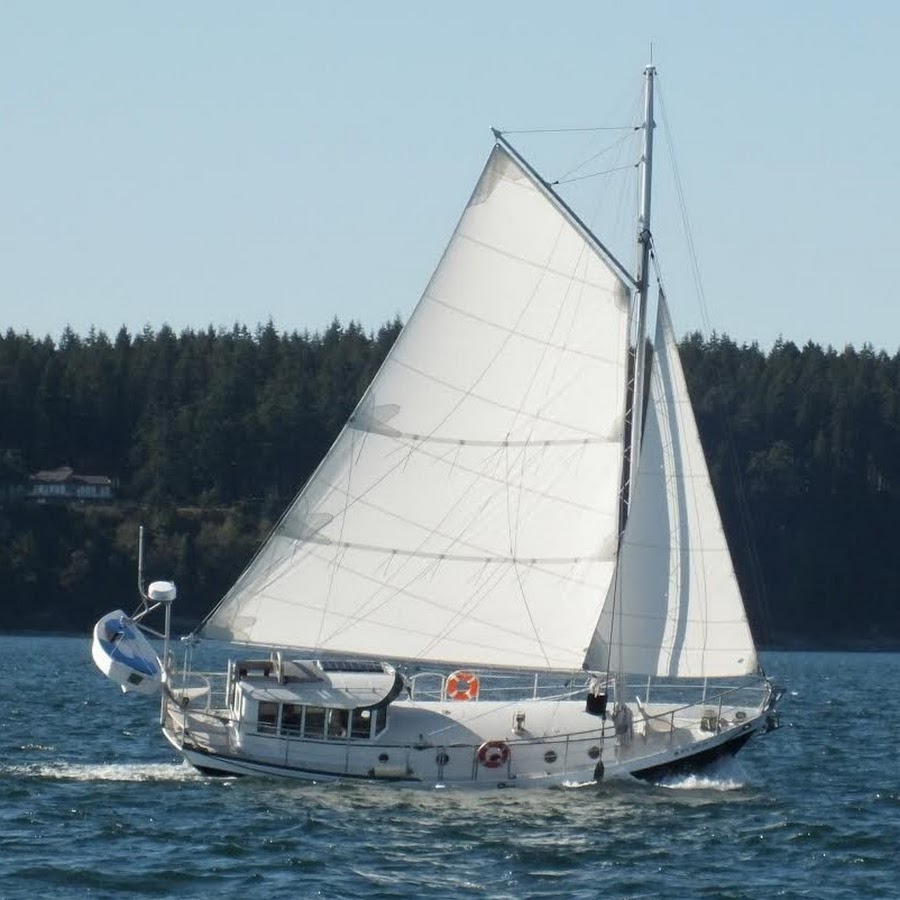
As was recommended here, I checked out the anchor test videos by YouTuber Steve Goodwin. His channel, named after his boat, is SV Panope:
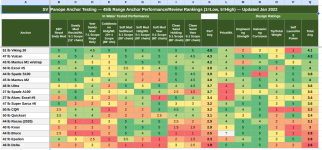
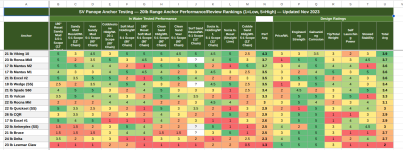
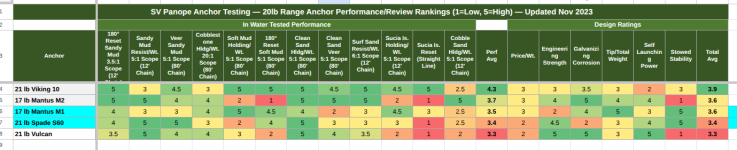
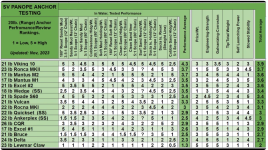
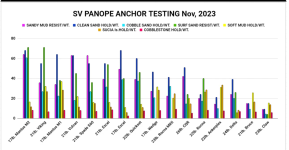
I was interested in the 20lb anchor tests (doubtful I'd get one that big, but it was closer to my world than the 45lb tests), and wanted to paste-in his summary table updated most recently in 2023.
1777026336361.png

1777027158509.png

After that, more recently, was a test of the Viking, Odin, and Ultra anchors, in which he says what many knew, that the Ultra (well over $1000) was the best non-rollbar anchor (note, the Vulcan by Rocna in the chart above is also a non-rollbar) and that the Odin, while good at some things, had issue with sandy mud and was not as good. He did not update/post this table in that video.

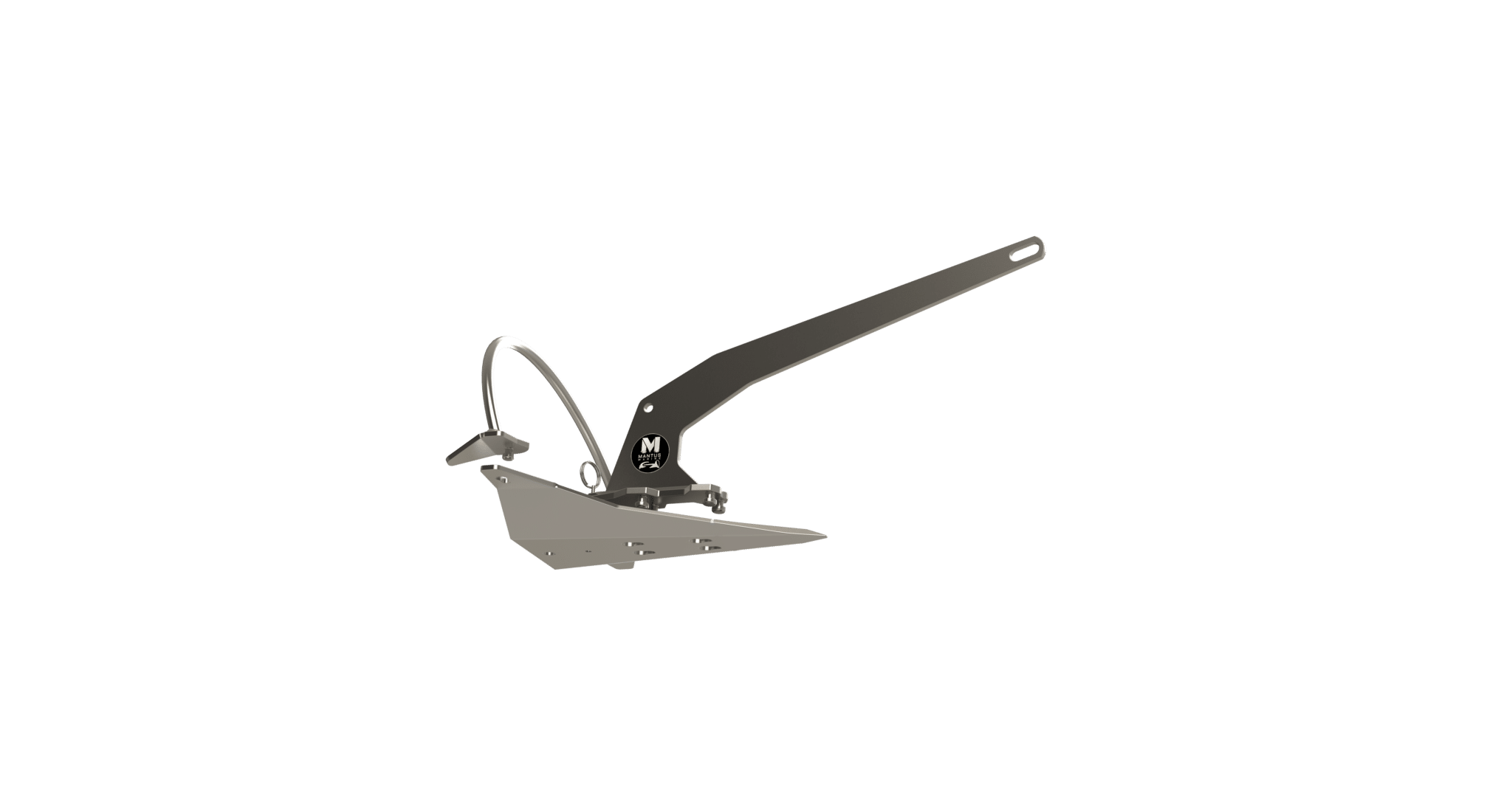
He also mentioned the new "performance" line by Mantus, which has scalloping on the shank for weight savings (getting a higher percent into the tip), and was cautiously optimistic that those versions, since gone to production, would have been notable improvements, but he has not yet tested them. He said if he gets some, those will be his next anchor tests.

In his second chart, which is organized by overall descending performance across all seven of his sea beds, he said a good measure is look at the 20 holding factor line and find anchors that are at or above that line in six of the seabeds. He said to rule out the red bars, the cobblestone-- no anchor does well there-- and you have a good overall winner. He said they were all rollbar type anchors: Viking, Mantus M1, Rocna MK2, and Wedge. He did say note the MK2 ("Mark 2") just barely gets past that line. He said Viking, Mantus, and now Wedge, were your best all around performers.

BUT, my strong recommendation to anyone like me looking at these videos and reading reviews etc., is to verify with charts/books what the most common anchor bed conditions you will encounter where you plan to boat. If you're in the Chesapeake, that's different than Florida, which is different than Maine, than Alaska, etc.. Also, verify the anchors against conditions you might encounter, such as big tidal reversals or high current tidal rivers etc, exposed areas with changing winds, etc.-- you want to stay put and sleep well.

It's like Consumer Reports ratings-- the highest performing 1-2-3 product might be the worst one for you. Eg, a Mantus M2 above was the #3 all arounder, affordable etc., but then is a 1 out of 5 for 180 degree reset in soft mud. If that's where you live, that would be perhaps the worst anchor for you.

Lastly, because I don't want to start a full thread with it, this guy Steve (Panope) put up a video adding a small mizzen sail/mast to his sailboat that was hunting/sailing/yawing at anchor, and has a time lapse video of it with/without (before/after) and the results were fantastic! I wonder if there is room for a mini one mounted to the outboard/transom that would have the same effect.


The two sources for the anchor chart and other comments:
 
Last edited:
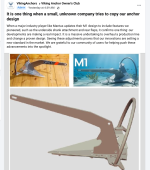
From the Viking FB page, it seems Mantus is following their design improvements now, too:
1777027958404.png
 
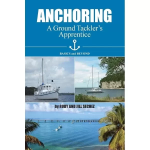
While I'm at it, I have a good book recommendation, "Anchoring: A Ground Tackler's Apprentice" (subtitle: Basics and Beyond) by Rudy and Jill Sechez.

1777029615762.png
Link here:

Unlike most "I sailed a lot and thus am qualified to write a book", these authors cite many other respected books/ works along the way, to try and take away some of the opinions (eg, referencing ABYC, Van Dorn, Hinz, Cordage Institute, etc.).

It's quite helpful in sizing and setting up your ground tackle for the conditions you expect to encounter, before you even get to the anchoring techniques themselves.
 
From that book...

loads on ground tackle, 20' sailboat / 30' sailboat, anchored in SAND with moderate protection, and freedom to oscillate
(there are other methods to test, in the book's appendix, but this was from the table). Moderate protection was defined basically as between good and poor, with lots of "what ifs" discussed. With less protection, they said you can add as much as 50% to the figures below. If the boat is secured so it can't oscillate, you can also add 50% to the figures.

30 knot wind:
360 lbs / 700lb

60 knot wind:
1440 lbs / 2800 lbs

Author Note: high windage boats (ie, trawlers, multi-hulls, houseboats, beamy boats, those with pilothosues, wind generators, solar panels, enclosures, arches, radar/TV/phone arrays, etc.) --> as much as 50% higher load on ground tackles.

So, adding 50% to the above:
30 knot wind:
540 lbs / 1050 lbs

60 knot wind:
2160 lbs / 4200 lbs

SURGE LOADS

I guess 1/2 the load on the ground tackle comes from wind, the other half from surge loads. Multi-hulls have surge factor that's 15-20% higher. Heavier displacement hulls affected to greater degree than lighter displacement, but no quantitative data, so they suggest applying same % as for multi-hulls.

Lots of good info on wind gusts < 30 seconds not really affecting anchor load (due to boat needing to overcome its inertia; more easily done for lighter boats), but that currents are the enemy. Not necessarily as much as straight line (adding a few hundred pounds), but if it takes the boat 30 degrees can increase the load by a factor of 2 to as much as 5 (!). Wind-driven currents basically do nothing, per the book ("As noted in Bowditch, a wind-driven current from a 60-knot wind where there is unlimited fetch is approximately 1.2 knots, a rather insignificant drag on the boat."). Of course, waves come into play in that situation, so up sizing is a good strategy.

Then, whatever you get for an acceptable poundage on the ground tackle for you, that's now the minimum work load limit for every component in the ground tackle. Per the book, rope per ABYC standards (I didn't verify this) should have a tensile strength of 8x the load on the ground tackle. Anchors should have twice the holding power, but a tensile strength of four times the maximum load on the ground tackle. Belaying points should be sized to have twice the strength of that of the maximum load on the ground tackle, while the fasteners which secure any belaying points should have 3x the strength of that of the max load on the ground tackle. For the windlass, its fasteners should be 3x of the windlass' rated load carrying capacity. Should anything be at the upper limit, up-size it. If any component will be subjected to a side load, up size at least one size.

So, one can sit and figure out just what they need to feel comfortable. The forum, and this book (and others referenced inside it) get into rope vs chain vs all the other factors and components, but I'm just at the anchor and rope part, and thought I'd share for others coming along later who are also scientifically minded.

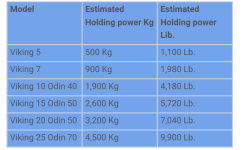
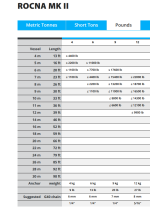
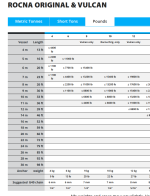
You can then take those loads and look into the various anchor size charts that show pounds, like these for Viking and Rocna (or Mantus: https://www.mantusmarine.com/m2-anchor / https://www.mantusmarine.com/mantus-anchors ), but be sure to read the disclaimer about conditions on the table. Some say they're conservative, some give the displacement units etc.. It takes some sleuthing sometimes, but when in doubt, for cruising, just go up one size from the one in the chart with your poundages. But, if there's so little a chance for you to be out in that situation, and you have a second you could throw out also, maybe the chart size would work just great for you and fit on your roller better.
1777032465927.png
1777032550239.png
1777032591915.png
 
Last edited:
Excellent write up. My experience with several thousand nights at anchor, in all sorts of conditions:
Most of the time, any anchor will do.
Mud, you need anchor to go down thru the mud to penetrate the clay or sand beneath the mud
Vegitation, the Fisherman or Northill is best
Sand: the Danforth High tensile or Fortress FX are the best.

For many of the years the only anchor I carried with racing sailboats was a Danforth HT. (West Coast USA, mostly sand).
I also used the CQR plow, not quite as good as the Delta, but very rarely drug.

In some situations I would set two or 3 anchors. What was holding well when first anchored, was replaced during the night as the boat drug slowly, was a different anchor. I have anchored in winds up to 90 knots; probably more in gusts. If anchoring in any wind, get all of the canvas off the outside of the boat. When setting 3 anchors they would be: CQR plow, Danforth Hi Test, and Fisherman--all in the 70 lb range for working anchors. My storm anchors would be twice the weight or in the 150 lb category. The chain would be rated for that anchor.

It is important to use a "Genuine"--not a knock off!!!! For example Danforth High Tensile, with the "T" on the inner part of the flukes, and high tensile steel. There are lots of copies of the "Danforth Pattern", of sheet metal, and rod shanks. I have never seen these hold as well as a genuine Danforth, or Fortress.

If I bought a C Dory which had a Delta Anchor, I continued to use that anchor, suppliment was a Fortress or Danforth HT as a second or third anchor. The fortress is quick and easy to break down, and stow under the Dinette compartment.

If I was outfitting a boat from scratch, The primary anchor would be a scoop type--with roll bar, or one which sets with the point down and will not roll over.

The secondary bow anchor would be an oversized Fortress, and the 3rd. stern anchor would be a Forthress sized as a normal working anchor for that sized boat. For rode I would ideally have 300 feet (500 if cruising the PNW) 8 strand Brait, and 1/4" High Test, G 4 Chain. Length of chain at least the boat's Lengh Water Line, up to 50 feet of chain. On my long distance motor sailors, we used 200 feet of HT chain. one size up, and two sizes up for the storm anchor We backed the chain wth 400 to 500 feet of 3 strand nylon. On these long distance motor sailors, we carried 6 anchors--for all different conditions, an in case we lost an anchor, or had to cut it loose. Thus we had a duplicate of our primary anchor (70 lb CQR), plus at least one smaller CQR and at least one Fisherman and two HT Danforth anchors.


I spent several days discussing anchors with Rudy Sechez, (Anchoring, A Ground Tackler's Apprentice) at our home. Also discussed anchors with Jeff Segal when he still owned "Active Captain". Earl Hinz (The complete Book of Anchoring and Mooring) asked for my opinion on 3rd generation anchors before he published the last edition of his book on Anchoring. I also gave anchoring talks at West Marine Trawler Fest, and Seven Seas Cruising Association GAMs--all 20 to 30 years ago. I consider first generation anchors to be the "navy" type or "Fisherman Type". The second generation includes the "CQR" plow, "Danforth HT" and propably the Bruce, although it might be the beginning of the 3rd generation. Third generation would be all of the scoops; Such as Ronca, Mantus etc. In many conditions they are the best. In "cobble stones" is where I have found the Bruce best--I have seen utter failure where the Bruce or Claw, could be winched back to the boat, and a Fortress would hold in the same sand. For the 22' to 23' C Dory I have carried the 14 to 15 Lb 3rd gen. anchors, and the 25 to TC255 boats; the 20 to 22lb. 3rd gen. anchors.

For mizens sails as a riding sail to be effective they must be flat--not sail shaped. You can also rig a riding (anchoring) sail, hanked onto the backstay of a sloop, and strapped down forward. My experiments with mizen or riding sails have not been as dramatic as in the video David linked above. Our C Dorys do "sail", but I have never felt it necessary to fit a Mizzen mast. The hull of a C Dory is far different than the hull of a nordic motor Sailor.

 
Great.

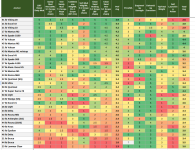
I started my narrowing down by copying Steve Goodwin's table above into Claude (AI) and having it convert it into a color-coded spreadsheet (1=red --> green = 5). I focused on what was important to me personally where and how I'd be using it, and got my final 3 to then price-out. But out of a hunch, I went back and checked a larger size of the anchors on his channel and was surprised to see some differences between weight classes of the same anchor. That gave me pause, because what if the smaller 13lb sizes are not as effective as the larger ones, or vice versa etc-- and why? Maybe larger rollbars plowed like snow, and a smaller one may not have the necessary scale, etc..

So, here are the two anchor charts, color coded:
1777129070505.png
1777129089210.png

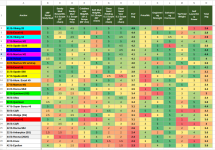
Then I combined them into a single chart, looking for patterns. There were some categories in one chart not on the other, so I had to temporarily removed those, map it a bit, and re-do the averages to reflect only those categories appearing in both charts. Here is the combined chart.

It shows that, for instance, the Bruce is a bottom performer in both sizes against its peers (for THAT person's tests). And that Viking was a top for both sizes. Shows a good swing from the older generations to new, also. And generally how the size of the anchor affects its placement. I'll poke around some more, as I enjoy this sort of thing.

Reminder, this isn't comparing a 50lb to a 20lb, it's just looking at general placements of same-class performance, to see which ones travel together with size and which ones actually differ and how.

1777129881428.png

EDIT:

Like this. I started coloring named pairs, and seeing which names were at the top for both sizes. And then Excel was really spread out. Not knowing enough, I'd just as well delete that one as saying "can't rely on tests". The Quickset was close for both sizes, showing it scaled well, but was pretty "middle of the pack". Viking, Mantus M2, and Vulcan scaled well.

1777130648744.png
 
Last edited:
The reality is that no matter which of the "spade type" (Viking, Excell, Mantus, and the host of others) you cannot objectively see a difference in your boat and where you anchor. The tables are showing major tends, but in that perticular sea bed. There are literally hundreds of anchor tests which have been done through the years. They are are generally the same. Sticking with one good spade type and one fluke type (such as Danforth, Fortress and Guardian). If you are exclusively going to boat where there is sand, and you only want to carry one anchor--then the Fortress/Guardian. If you are a mixed bottom, with sand, gravel, clay and mud then the cheapest of the spades you can get at that time.

Why are "Fortress Anchors better than Guardian?" The patterns and materials are exactly the same. The Fortress has two positions of 32* and 45* fluke angles, the latter for thin mud. The Fortress is anodized, so it have less corrosion. One of the Fortress I use on my 18' Caracal Cat is a Fortress Fx 7 has some corrosion. It had hard service from a neghbor so I picked it up cheap at a yard sale. Since I use the anchor relatively infrequently, and am able to wash it in fresh water after each use, it would be just as fine as a pristine new anchor for my purposes. Spoiler: if I am frequently ancohoring in mud, I drill the shank of the Guardian. G6 I own for the second or 45* position--and it works as well as a Fortress.

One other consideration not mentioned is the retrieveal if the anchor is "stuck"--you don't like to leave any anchor, let alone a very expensive and perhaps irreplaceable anchor on the bottom of the sea. The "getting out safely" is usually accomplished by pulling on the crown--some put a second line with float attatched to the crown, or have a slider for the primary attatchement. With a pull in the opposite direction, it breaks a zip tie, which has held it in the end of the shank, and slides down the the shank to deliver the pull in the opposite direction of how the anchor set. If anchoring on a wreck, some divers and fishermen, use an anchor made with mild steel tangs such as rebar in at least 6 directions (3 pieces of rebar) and the anchor tines can be reshaped when you get it to the surface.

Several issues with the trip line and float: Other boaters think it is a pick up for a mooring--I write on mine, "Trip line, do not use". The second issue is that a boat runs over the trip line and it tangles around the prop or running gear of another boat.
 
Thanks. I’m trying to vacuum up all that I can from as many trusted people & places I can, so I don’t need to revisit it for 20 years beyond implementation learnings. If I do that for enough parts & systems & strategies, I ought to have a great running start when I wander beyond home waters. No substitute for experience, but still. What was the Eisenhower line? Plans are worthless but planning is invaluable? Something like that, to a degree.

As for now, and anchoring up where we boat, I’m most likely going to try the Spade S60 twenty pounder and a Fortress FX-7 (genuine).

I don’t anticipate needing a storm anchor yet, beyond having those two to deploy simultaneously if need be, on account of where I’ll be, the short duration of our planned go/no go trips, and that I’ll have family aboard so not taking chances with conditions. At least the next couple years anyways.

That said, we had a sudden squall last summer here with 70mph winds (at the noaa station buoy), minutes after our neighbors boated to dinner in the sunshine. I saw videos from boats in the nearby mooring field, getting absolutely thrashed, canvas getting ripped, things ripping off, etc— nuts and gave no warning. Microburst thing; we personally lost several large tree limbs, and there were many full trees downed around town.
 
Why did you choose the Spade S 60 over the other anchors?
Thank you
 
The Viking anchors are testing as the best overall anchors anywhere right now. This not only from Goodwin / Panope testing, but also how Mantus has incorporated some of their designs, and anecdotal forum/group evidence. So to answer the question, "what is the best anchor", knowing it could be rebutted with "best at what, for what, on what", there is no singular answer.

However, for "best at holding in varied sea beds, without a crazy price tag", it's the Viking-- and they scale top performance across sizes, showing it's a ratio / design that works. Long pointy snout, big roll bar, balance, shapes, etc.. Shipped they're 370 euros + 115 euros shipping = $568 today per Google currency exchange calculator.

Panope did say it will not self-launch, however, so if you're auto-launching from inside a pilothouse, you'd have to get an angled bow roller that helps deploy it. Also, as a reminder, many of us don't use "varied sea beds" and so it's important to "anchor maximize" to suit your personal needs.

If you have a boat that can't accommodate a roll bar like on the Viking, the next best overall performing is the pricey Ultra anchor. This tests / anecdotes better than the Odin by Viking, a bit better than the Mantus M2, and decently ahead of the Rocna Vulcan (13lb Vulcan 6= $$530+ tax; 20lb Vulcan 9= $640+tax). The Ultra is "ultra expensive", though. For the 18lb variant, it's $1155 + tax. The 11lb is $825. (Sure is pretty, though!)

The next best overall anchor, down from the Viking, based on testing from Panope, other videos, forums / anecdotes, etc., is the Mantus M1. I would assume the new "borrowing from Viking's book" Mantus M1 Performance is better than the M1, and thus would take their word for it based on how well their other anchors do, are favored, and how Viking put a post up showing which features taken by Mantus were first on the Viking.

The Rocna MKII is also right up there, and available anywhere, and is basically a draw and a brand preference for most conditions-- but that brand comes with a huge price difference. For example, a 20lb range Rocna MKII is $800+ (13lb is $650 + tax), and the 17lb Mantus M1 Performance is just $340 after shipping (on sale through today April 26; add $100 for non-sale). The Rocna is just not testing at nearly 3x the performance, so it's easy to write off for me.

The Rocna MKII's performance did scale with size, though, which was something I looked for (not just for "proof" that it was the design of the anchor rather than the seabed, but so if/when I get a larger boat in the next few years, I don't need to re-learn everything until the next generation comes out-- then again, tires have been round a long time, so I was hoping to make this the choice for the next 20 years, changing only if I find I'm not setting as well as others in the same area, which I read can happen). The Viking, Mantus, and Spade also scaled in step.

I had a regular Rocna (first gen Rocna) on my daysailer and had great luck, but was annoyed at how much foul smelling muck it would bring to the surface in my area. That's "load bearing muck", which I get, but was hoping for less cleaning this go-round. I also didn't like the roll bar always hanging on the front like Rudolph with buck teeth. If it was a game-set-match superior anchor, sure-- function before form-- but you can get damn near close without the roll bar, provided the shank/tip balance and angles are good (like the Ultra, which is a fancy Spade-- which came out in I think it was 1990).

I used Goodwin's / Panope's charts to narrow my list down to prioritize 180 degree reset and veer holding, based on how much our boats yaw / hunt at anchor. I can see situations where wind and waves might be at odds with each other, adding side loads (increasing load on the anchor), and with my plans to boat around Downeast Maine near my in-laws where they have 10 foot tides, it's a faster change of direction than down here in RI with 4 foot tides. I also really liked what I was seeing and reading about the Mantus M1, and obviously the viking, so my finalists were Viking 20lb, Mantus M1 Performance (17lb-- they have a 13lb, 17lb, and 25lb; I especially liked that the 17 was more than the 13lb class but less than larger 20lb class). I also liked the fact Mantus was a US-based purchase and therefore easier, not subject to import nonsense like the Viking, and was more or less just as good, plus basically half price.

So, I got down to these as my finalists (I deleted the Rockna MKII based on price, same with Ultra) (based not just on this chart-- I did lots and lots of other research, but the charts are easy to keep showing here)
1777208383649.png

Knowing that a fisherman's is best for eelgrass and kept etc, and that I wouldn't be carrying Popeye's anchor on the C-Dory (though that would be very cool to me, ha), I read and listened to a fair amount of anecdotes that the rollbars often "foul" with seaweed, leading them to get stuck on their side or to not reset properly. I also read that the roll bars are occasionally a liability in deep soft mud, preventing them from getting down further. There are deployment tricks, like dropping and waiting a while before setting, but I'd rather not deal with that if possible (though prudent anchoring is always required-- don't leave or go to sleep until it's actually set, duh).

I really didn't want a roll bar anchor, aesthetically (having been there), but it was hard to dismiss the Mantus M1. Based on price and availability, and what I consider "too many exposed nuts and bolts", I chose against the Viking. I also chose against the Mantus M2 due to its poor reset in soft mud. The Vulcan was too expensive to its peers, wasn't as good, and was too "curvy" for me visually. So, I was down to the Mantus M1 Performance and the Spade S60.

In the Anchoring book I shared earlier, they said of all the non-rollbar scoop style / new gen anchors (and the Spade was really the first of that new gen), it was the only one that didn't just drag across the mud without resetting in the 2014 Chesapeake Bay (I.e. soft mud) tests (book isn't new). I looked up that test, and they used the 40lb category. And, since that anchor scales well based on size, I had good reason to believe it would be true for the 20lb one. The "4" in the chart above for soft mud reset tracked with this (and also why the Vulcan was tossed).

The S60 galvanized Spade is $484 + shipping. I called and was told it'd be around $40-50 to ship, so let's call it $530 delivered. Compared to the Mantus M1 Performance (and again, I have no testing or anecdotes on the Performance line other than it took a very good anchor and adding stuff from a better anchor, and so that seemed good enough to me), at $340 shipped, I was again nearing that 2x anchor for not 2x performance. But, it was no rollbar (might not mean much to you, but it did for me-- and I acknowledge the yellow will chip off probably sooner rather than later).

There was a bad batch of Spades out there with poor galvanization-- same of Rocna-- and so they needed to be re-galvanized sooner than some people hoped. Spade has a hollow tip and fills it with lead so that it's very tip-heavy. If re-galvanizing, one must melt that lead out, galvanize, and re-add the lead. There are a few reports of second-hand ones that were done without enough lead, causing poor performance. This also lead to poor setting in harder bottoms and with less than 4:1 scope. In a crowded anchorage with 3:1 for daytime to fit, that was not ideal. But, that's also not where I plan to be. There's also new guidelines for more chain-heavy rodes, vs the old 5:1 or 7:1, being something like 50ft of rode + 2x depth (or 4x if rope/chain rode)-- the chain is proving to do a lot more than was given credit for earlier on, as some Brats are sharing. There's a limit on a 22' boat, but I felt it worth mentioning in this context.

I read cruising forums about Maine and New England waters, and the Spade (which is harder to find now that West Marine no longer carries it-- there is only one US based dealer, which was nearly a deal breaker, but they're ubiquitous all over France and the mediterranean) tests very well in most cases.

[character limit]
 
[second half]

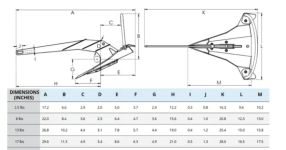
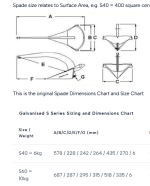
Then it came down to size and shape-- something to help tie break. They're both rated for our boat size and anticipated storm loads. Physically, the Mantus M1 Performance size:
1777210596954.png

1777210617497.png

From bottom of tip to top of shank on the Spade, the "D" is 315mm = 12.4 inches.
From bottom of tip to top of rollbar on the Mantus M1-P, the "B+G" is 16.2 inches.

Width of the scoop on the Spade, "C", is 11.6 inches.
Width of the scoop on the Mantus, "L", is 16.5 inches.

Distance from furthest side of chain attachment hole to hull-nearest pointy tip of Spade, "F", is 13.2".
Distance from furthest side of chain attachment hole to hull-nearest pointy tip of Mantus M1 -P, "H - F", is 14.7".
On this one, I believe the shape of the Spade will actually keep the tip further away from the hull than the Mantus M1 -P.

I also liked that the Spade had a solid shank and parts, whereas the Mantus (and almost all rollbars except the MKII) are hollow, meaning you need to clean out the muck carefully or you get cement and it throws off the balance and can lead to breakdown of the galvanization and lead to hidden corrosion.

So, with the better aesthetics to me, the smaller visual size, the heavy tip, the superior setting and veer in the sandy mud (most of where I'll be), the no roll bar for seaweed or impeding "set it and wait" deployment (better for getting down into soft mud), and presumably not needing nearly as much alterations (if any) to my bow roller, the good anecdotal performance for my cruising grounds, and without the typical "scoop [up the muck]" shape, and the fact that it's a bit different but also proven, I decided to pay the $190 price premium. The lower the prices, the more wonky the percentages seem ("oh that's a 55% premium!"-- yes, but $5 vs $10 is 100%, and in this case I think I'd even gladly pay $190 divided over 10 years = $19 a year to not look at a giant hoop again on the front of my pretty little boat. If it also means I get less muck, and have better performance, well then it's a clear good choice to this Brat.
 
Waiting to place Spade order today (phone only; closed over weekend), but in the meantime I just bought a Mantus 2.5lb stainless steel dinghy anchor which I'll also use as stern / shore anchor in good conditions. Folding rollbar, great tested performance, trusted brand. $105 (+$40 shipping, with a bag and some extra tip covers; supplying my own rode so I can ensure rope quality and desired thickness/length), so a lot per ounce if it were buying meat, but I'm happy to have it.

 
I also just bought a Fortress FX-11 for backup anchor, $244 after tax at West Marine ($229, same as Defender).

I opted for this over the FX-7 (my original plan) because the FX-11 could serve as a backup bow anchor on my 22 whereas the FX4 could not, and the Mantus 2.5 dinghy anchor could serve as stern anchor but not bow. So, now I basically have two bow anchors and two stern anchors, and the option to deploy two for storms, but if I got the FX-4 I'd really have one bow and two stern. If I was on a trip and couldn't get my primary anchor up, I'd then have to go home or buy another anchor; I like the redundancy.

Being aluminum, the FX-7 was 4 pounds and the FX-11 was 7 pounds (oh no, 75% more!), so that 3 pounds extra difference was meaningless to me compared to the additional holding power per their charts, which are good holding in 30 knots (they remind buyers that forces of a 42knot wind are 2x greater than those of a 30knot wind-- so, deal with the 3 pounds). And if I have issue with the spade in mud, the fortress may have better luck with its adjustable shank and optional mud palms (those I did not buy this go-round).

It should disassemble just fine, and I'll likely stow it under the dinette wrapped in an old towel.
 
Completing the exercise (can you tell I'm a former high school teacher?), initially the anchoring charts said (pasting from above but adding in 45 knots):

Loads on a 20' and 30' sailboat (either side of the "/" below):
30 knot wind:
360 lbs / 700lb

45 knot wind:
720 lb / 1400lb

60 knot wind:
1440 lbs / 2800 lbs

BUT high windage boats (ie, trawlers, multi-hulls, houseboats, beamy boats, those with pilothouses, wind generators, solar panels, enclosures, arches, radar/TV/phone arrays, etc.) --> as much as 50% higher load on ground tackles.

So, adding 50% to the above:
30 knot wind:
540 lbs / 1050 lbs

45 knot wind:
1080 lbs / 2100 lbs

60 knot wind:
2160 lbs / 4200 lbs


So, the anchor is sized, now for the chain. No windlass, but I'll add one eventually. Lewmar 700 horizontal takes 1/4" ISO G4 type, which has working load limit (WLL) of 2,600 lbs. That exceeds the force on a 20' high windage boat in sustained 60mph winds, and exceeds those on a 30' one at 45knots-- these both in moderate protection (not "good"). As mentioned earlier, 50% -5x impact if side loaded and twisting or prevented from oscillating, or with worse protection. I think with our shallow draft, we'd be able to "find" good protection should it be a sustained 60knot storm. And if a sustained 30knot in moderate only, and you took the 540 (up 50% already) and then 5x'ed it, you're basically at the chain's limit. So you'd have to try hard to put yourself in a situation where you'd break 1/4" chain on a C-Dory 22 (saying nothing of safety factors built into the chain beyond the WLL).

ABYC says rope should have tensile strength of 8x the ground tackle load. The windlass mentioned takes 1/2" 8-plait or 3-strand. Let's see if it matches. Per Defender's rope page, "Tensile strength is the average strength of a new rope under laboratory conditions. This is determined by wrapping the rope around two large diameter capstans and slowly tensioning the line until it breaks. Some manufacturers refer to this as Breaking strength.". Over to West Marine, they have New England Ropes 1/2" 8-plait braided nylon rope. This shows 8,000lbs breaking strength. Working backwards from the ABYC 8x, that means they'd want the load to be no more than 1,000 lbs. This takes you back down to the 45-knot wind rating, for the higher windage boats (or almost to the 60knots on the low windage boats). The 3-stand has 7,500.

So, you'd have to acknowledge-- if you wanted to be Captain Prepared for Hurricanes and adhere to that 8x rule with your primary rode always attached to your bow and running through your windlass, that your Lewmar 700 horizontal windlass is too small. Nothing saying you can't use it and swap out for a beefier rope in a storm, obviously.

What size backup would you need to carry on board, though, if you DID want the full (example) 2,160lbs? well, 8x= 17,280 lbs breaking strength. Per a chart on West Marine, 3/4" 3-strand gets you to 17,150 lbs. 1" gets you 22,300 lbs. Going to the 8-plait, 5/8" gets you 11-12,000 lbs; 3/4" gets you 17,500.

So, something for everyone to consider in terms of how well prepared you may actually be according to standards. It helps take some of the opinion out of it, and lets everyone find a "I'm okay with that level of risk" number/size for their anchors, shackles, cleats, chains, and lines (standards exist for all of those things). But for most of us, under most conditions, whatever you have will work good enough most of the time. It's just knowing to trust your gear that comes faster with an assist from "math".

Me personally, I don't have a windlass but will be adding one, and thus going to stick with the 1/2" 8-plait, which should hold me fast in all conditions I ever anticipate being in or don't. Sustained over 45-knot winds in not-good protection, just isn't something I plan to encounter-- and now it's not a "this should be good enough choice based on what I read", it's a "this should be good enough because I made my own informed decision."
 
Well, Spade USA called me back and it does not appear it will work out for me. They import from Europe and the tariffs are crushing him. He said they were much higher than he expected on the batch in port right now, and he does not believe it will make sense to have any more brought in. That is what he’s doing today – – working through the margins to see if it even makes money. He has no 60 size in demo units and he is almost certain he does not have any 60 sizes in stock, but will check for me this afternoon. That would mean the very end of spade in the United States for the foreseeable future, and that I would be going for used or a back up anchor plan like buying from Canada for a lot more money or just getting something else from my list. Dear diary, screwed again lol
 
You could order a Lewmar windlass with a different gypsy to accommodate a 5/8- 8 plait/3/8 chain rode if you would like to be more prepare for a big storm. I’m only saying that in case you wanted to include more options in your decision process.
BTW, I really enjoy reading your post and all the detail/research you put into them.
I did added a windlass on my 22 cruiser and keeps it at the standard 1/4” chain-1/2” 8 plait and was comfortable with my choice also.
 
You could order a Lewmar windlass with a different gypsy to accommodate a 5/8- 8 plait/3/8 chain rode if you would like to be more prepare for a big storm. I’m only saying that in case you wanted to include more options in your decision process.
BTW, I really enjoy reading your post and all the detail/research you put into them.
I did added a windlass on my 22 cruiser and keeps it at the standard 1/4” chain-1/2” 8 plait and was comfortable with my choice also.
Thanks. I suppose it's worth adding that I'm not doing it in doubt or in fear, but in trying to learn for myself about anchoring, where things go wrong, and where people's strong opinions are made and/or changed, and then share it for anyone else curious enough to read words these days. I saw so many "what anchor and rope should I buy" posts here and across several forums, FB, etc. This seemed a topic worthy of "go figure it out", rather than something else I'll need and just want an answer, like "where can I get the window seals please just tell me", not because I value it more, but because it's actual people and property at risk. Sure, the 22 is a nearly flat bottom, pointy, corky boat, that can tuck into a puddle, so even with high wind, I don't see hardly any danger for a C-Dory 22 at anchor, but I wanted to learn the thought process that will let me scale it faster than my time available for trial and error-- and share it.

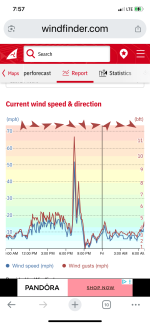
I also was simply shocked last year by a microburst which turned our river from sunny placid to "holy sh*t!" wind and fetch in minutes, and wanted to know for sure the limits of my gear for our trips to Maine etc. If you were rock climbing or scuba diving, neither things I do, you'd want to actually know rather than just say "that should be good enough" or "I went one size larger, that should be plenty" or "most people seem to be using this". Here, I went through my photos and found the wind chart for that burst (measured about a mile away from my house on a buoy in the adjacent Providence River). It really came out of nowhere!
 

Attachments

  • IMG_6914.PNG
    IMG_6914.PNG
    231.1 KB · Views: 3
I totally understand your thought process, One of the first thing I did when I got my CD 22 was to upgrade the anchor setup, so I first did some research to make more informed decisions, like how much chain should I get, what should be my total rode length be, what anchor. Knowing all that doesn’t add fear but more confidence in your decision when anchoring and knowing the limitation of your gear and when to make changes.
I have been caught in a few unexpected storm, and had to make changes at times. One unexpected storm from an unexpected direction put me at the wrong place at the wrong time. The bay I was in did not offer protection for those conditions, it had a little nook that was protected from the wind but was not a recommended anchorage because for 1- that area got dry at extreme low tide ( I was lucky that that day I was going to have 2 ft to float my boat, made me very happy to have a shallow draft boat). 2- the soft mud bottom did not provide good holding. Knowing all that I decided to duck in there and use my stern (Danforth) anchor as my main in the middle of that pond and use my bow anchor on the beach. The storm had passed the next morning, the boat did not move from where I wanted it and I actually get to sleep some that night.
With less knowledge, I would have probably made different decisions and would had most likely had a different outcome.
once again, I appreciate you putting your thought process in here.
 
If you are going to relate your anchoring to the extremely rare condition where the wind goes from 10 k to 70 k, there is no anchor or rode system which will guarantee holding. When a strong wind hits, and once your anchor starts to drag, then you are in very serious trouble. The anchor most likely will not reset, and will skate across the bottom. In those conditions you better have. your engine started and ready to roll.

I have been in conditions where the holding was not as good as ideal. Once the boat began to drag, I already had the engine started and had handed out sharp knives to my wife, son and daughter. As I put the engine in gear and reved it--I yelled cut the lines. We had already drug a significant distance, but were rapidly moving away from the lee shore. It took us several hours diving the next morining to find our ground tackle. This was in a boat which weight was about fifteen times that of our C Dory 22's. That boat had a very substantial full keel and 7 foot draft. The C Dory will skate across the water, with almost zero grip of underwater appendages.

I would caution if one tried to use 3/8" G4 chain (weight twice as much as 1/4" G4 chain 1.5#/ft vs .75#/ft.). Then there is the volume issue--compounded by the larger volume of the 5/8 rode both on a reel drum and in the anchor locker--and inadequate fall for the chain that might bring. Also the deck attachment point and damage done to the C Dory if these speculated loads were applied (ripping fender washers thru the deck etc.). The elasticity of the whole system is also important. Once above about 40 knots of wind there is no cantary in the chain, and even with a kellet, that chain will not provide the shock load protection necessary. Usually shock loads is what breaks chains, not the steady pull. Even if you use snubber lines, what would they be cleated to to withstand the types of loads speculated here? In other words--stay within the bounds of what the various parts of the entire system will stand. Real world anchoring is a lot more than the ground tackle.
 
Very neat you lived all this stuff. I was reading about that earlier in one of my books-- how in big storms and waves the weak links can quickly become the cleats, fasteners, backing plates, and even the fiberglass (and CE hull ratings etc)-- and found the whole thing neat. Makes you appreciate when someone says a boat is a coastal cruiser more than a bluewater passage maker type, beyond just waterproofing hatches etc..

Also reminds me of a documentary I saw a year or two ago, "The Sailor" about Paul Johnson (sailor-boatbuilder-alcoholic):


and how he had some good stories in that booze-sogged brain of his. It was available for free on Prime when I watched it, and with commercials on YouTube (I can't do commercials anymore). I am not comparing the two-- if anything, contrasting-- but it came to mind with another one of your good stories.

Seems still on Prime:
 
Back
Top