
Upgrading AGM to LiFeP04 house batteries - Advice?

CC Rider

Member
Joined
Nov 18, 2013
Messages
170
Reaction score
1
C Dory Year
2006
C Dory Model
23 Venture
Hull Identification Number
GXK23015K606
Vessel Name
CC Rider
I am looking for advice and product recommendations for changing out my current AGM house battery bank to a LiFeP04 bank. Also thinking of adding a solar panel or 2 for the house bank in the near future. (200W or so..)
I usually carry a Honda 1000i for charging the current system when on the hook for more than a day or two...

My current system consists of:
(2) Group 31 NorthStar NSB-AGM31M batteries which are almost 10 years old and have served me well, but are noticeably degrading in capacity. These are mounted under the V berth.

(1) Mastervolt Chargemaster 12/25/3 triple bank charger to charge the house bank, the starter battery (FLA) for my 2006 Yamaha F115 main, and a starter battery (FLA) for a Yamaha 8 hp kicker.

(1) Blue Sea SI-ACR automatic charging relay used between the house and main engine start battery

(1) Victron 702 battery monitor with the shunt currently connected to the house bank and the second input to monitor the voltage of the main start battery.

I am looking at purchasing (2) LiTime 140 AH Group 31 batteries to replace the AGM's under the V berth. This would not only increase the capacity of the house bank, but also save a bunch of weight in the bow of the boat.

I am thinking of buying a dedicated LiFeP04 charger (possibly a Li-Time 40A), disconnecting the current connection from the Mastervolt and only using the Mastervolt for the 2 FLA independent engine start batteries. The new LiFeP04 charger would charge both new batteries that are of course wired in parallel.

I will need charging for the new bank from the Yamaha 115, so a DC to DC charger is going to be required. Some of these apparently have solar inputs as well, so looking into the future solar panel setup, buying one of these units would save buying a separate MPPT solar controller... It is also my understanding that some of these units will serve the purpose of the Blue Sea SI-ACR by not pulling power from the main battery unless the motor is running. I believe the Yamaha only has a 35A alternator.

With the upgrade, should I remove the Victron shunt from the house bank (since the LFP batteries have bluetooth connection for monitoring) and connect it to the main start battery to monitor it?

I don't have an inverter, and don't plan on running one.

Any suggestions would be welcome!

Chris
 
Just a thought, could you use the same battery for main and kicker? Could be wire to a 1-2-both switch to keep them isolated from each other, that will save a litter bit of weight and expense.
I did that conversion last year with LiTime 100AH (X2) charge with a Victron Tr Smart 12-12-18, work perfect for me and look to be about the right size for your 35A charger but they do not have any solar input, the newer 50A might and is adjustable, the 18A and 30A are not. The LiTime APP on the phone is nice but I’m not sure if it is as accurate as a good shunt, it is not much of an issue for me since I don’t draw a lot of power at anchor and have not taken it below 50% last year. So a little inaccuracy will not affect me much.
Yes, the DC to DC charger will replace the ACR
I’ll let others with more knowledge then I have answer your remaining questions.
 
You could use a single ~300Ah battery instead of dual batteries. Lithium batteries are not meant for starting engines (although there are some that claim that they can). Boat motor alternators may not be able to support the current load of charging Li batteries without some sort of intermedary device (DC-DC charger).
I would have a Li battery for the house. A FLA or AGM battery for starting. A DC-DC charger to charge the Li battery. Setting up a system like this will probably require rewiring your boat (this is the reason I haven't done it yet), but I have done this setup in a van.
If you add solar you need an MPPT charge controller. You can get one that will also charge your starter battery after the house battery is fully charged. Renogy makes a charge controller that does solar and DC-DC charging.
WattCycle "dumb" batteries are more highly rated than LiTime batteries.

Search for Will Prowse on YouTube for lots of information and reviews of Li batteries.
 
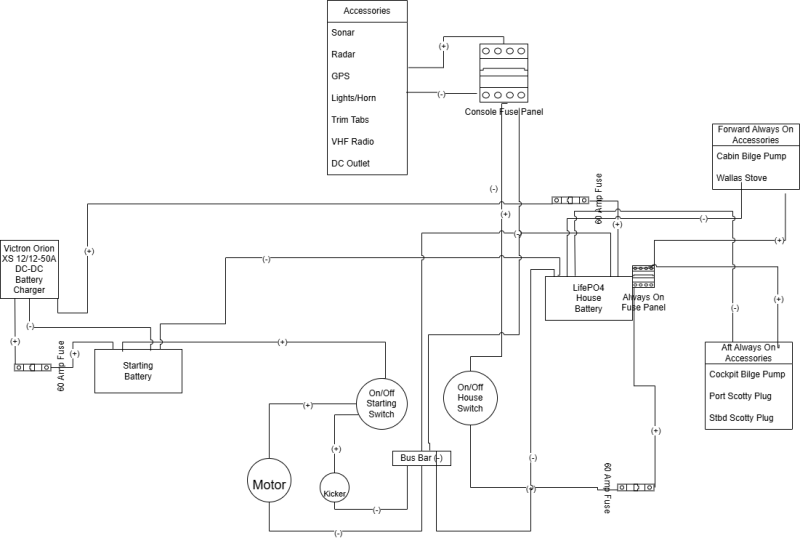
I am using the Victron Orion XS DC-to-DC charger, which is substantially lighter and smaller than their older options. Here's a rough diagram of my setup with a single LiTime 100Ah Bluetooth battery.

full


I mostly fish and do not run too many always-on electronics (no fridge/freezer). LED cabin and anchor/nav lights. The lithium battery is rarely under 97% full during day use while motoring/trolling, and I've gone out on a few 1-2 night trips without running out of juice. I have not needed to plug into shore power over the past year, but I carry a Victron charger just-in-case. The motor has kept the batteries topped off otherwise.

I thought about solar but have not found the need for it yet. It might be worth investing in if you're on extended cruises on the hook or have more always-on devices. I believe the general recommendation is to have a separate MPPT controller for each panel, so you might take that into consideration when evaluating the all-in-one charger/controller vs. separate unit options.
 
Just a thought, could you use the same battery for main and kicker? Could be wire to a 1-2-both switch to keep them isolated from each other, that will save a litter bit of weight and expense.
I did that conversion last year with LiTime 100AH (X2) charge with a Victron Tr Smart 12-12-18, work perfect for me and look to be about the right size for your 35A charger but they do not have any solar input, the newer 50A might and is adjustable, the 18A and 30A are not. The LiTime APP on the phone is nice but I’m not sure if it is as accurate as a good shunt, it is not much of an issue for me since I don’t draw a lot of power at anchor and have not taken it below 50% last year. So a little inaccuracy will not affect me much.
Yes, the DC to DC charger will replace the ACR
I’ll let others with more knowledge then I have answer your remaining questions.
Hi Stephan;
Thank you for the reply, while it would be nice to decrease the weight of the 2 FLA start batteries by using only a single one, I prefer to keep the 2 engine start batteries as separate systems. I power my downriggers and pot puller from the kicker's battery, and the kicker has electric start and power tilt.

I found a Renogy 40A DC to DC charger with MPPT on Amazon for $158 CDN which seems like a good deal. Unfortunately this unit will likely damage the Yamaha's 35A alternator. There is a Renogy 30A unit on Amazon for $ 260 CDN.....why this is more expensive is beyond me.. and may still overload the Yamaha.... not sure about this. I may just go with a standard non-MPPT DC to DC LiFeP04 charger in the 20A range and just buy a separate MPPT solar controller.

I need to keep the (2) Group 31 profile batteries idea, instead of a single larger unit because of the work already done under the V-berth to mount the old Group 31 AGM's

For shore power charging of the two 140 AH LiFeP04 batteries, is the advice to go as big as possible, say 60A or perhaps a 40A is wiser?

Thanks in advance,
Chris
 
Last edited:
I used the 80 amp battery charger on the Victron Multiplus 12 2000/80/50 as the shore battery charger. I prefered to use a user setable DC to DC charger: Sterling: max 30 amp DC to DC charger. The newer "Saturn" from Sterling comes with 6 preset profiles and one user setable profile.

On the single battery setup, I use the Orion by Victron--18 amp is plenty, for the single 100 amp hour battery I use in the portable car rig. No stress on alternator of car engine. I can see the use of solar panels on month long trips, where you often stayed in one place. For between uses, a 35 watt "trickle" charge solar panel is plenty to keep the start and house battery topped off. The outboard motor alternators kept the LI and FLA or AGM house batteries well charged if we were running every other day (your charge may very dependant on length of time the outboard is run.
 
When purchasing a LiFePO4 battery make sure it is listed as having GRADE A cells. If grade is not mentioned it probably is GRADE B. There are a lot of Chinese, inexpensive batteries that are Grade B.
Summary from Google:
  • Quality & Standards: Grade A cells are premium, meeting all manufacturing specifications with consistent performance. Grade B cells are often those that fail to meet strict A-grade standards due to slight variations in capacity, internal resistance, or physical defects, though they are not considered dangerous or "faulty"
  • Cycle Life: Grade A cells usually manage 3,000-5,000+ cycles, while Grade B cells typically handle around 1,000–1,500 cycles.
  • Safety: Grade A cells offer higher thermal runaway temperatures and better stability under high stress. Grade B cells, while still usable, possess a slightly higher risk of failure or instability under high-current conditions.
  • Cost: Grade B cells can cost significantly less (often half or less) than Grade A, making them attractive for smaller budgets.
Manufacturing Grading Process
  • Grade A (A-Grade): Fully meet technical specifications for capacity, voltage, thickness, and performance. They are typically for electric vehicles (EVs) and high-demand energy storage.
  • Grade B (B-Grade): Derived from the same production line but fail to meet the strict consistency of Grade A, often displaying higher internal resistance or slight capacity variances.
  • Yield Rates: Top manufacturers achieve over 95% A-grade yield, whereas lower-tier manufacturers may produce 5–10% B-grade cells.
 
Back
Top