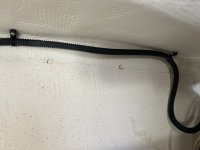
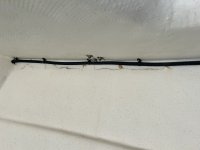
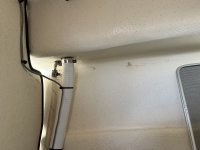
The photos really help and my 2003 boat which had been abused had similar cracks, but some actualy delamination of the tabbing holding the platform for the "V" berth in place.
The constuction you see is the inside of the hull to deck joint. It is a "shoe box" construction. The edge of the deck moldment is glued over the hull moldment. The joint is then reinforced by putting a strip of cloth/mat over this edge to cosmetically hide the joint and stabalize and strengthen the hull to deck joint. Also the rub rail goes over this joint on the outside, there are bolts thru the joint on the outside--and you can see them on the inside, as they were covered with a putty. Then the inside is spray gelcoated or spray painted.
It is a very strong joint. Since there are no water streaks, it suggest that there is no compromise with leaking around the joints. In my boat I just watched it, and no further problems occured, since I did not abuse (slamming into seas at a speed more than the boat is was designed for. Not necessarilly a weakness. It should be watched, and if you wish, you could put another layer of cloth over these areas, but the boat has survived for over 20 years without apparent damage, so I would just watch the cracks.
Now there is the other issue, which is very common. That is not only the deck of the cockpit under the pilothouse door, but the tabbing of the aft bulkhead to the hull all the way down under the deck and forward the fuel tank. Delaminating this is very common, in the early 25's and will allow water from the under cockpit deck to migrate to the floor of the cabin. This also may cause some water intrusion into the aft cabin bulkhead at the bottom of the structure. In a very few boats, the fuel tank needs to be replaced, and at that time the status of the hull under the fuel tank should be investigated when the fuel tank is out. Some are fine, some have had to replace the core. When done properly, it will be good for the life of the boat-which could be another 30 years. The transom should be evaluated in these boats with a moisture meter. Read David Pascoe's trietse on the Moisture meter:
Here is an article by Pascoe (RIP). There is also his book on yacht survey, and I think anyone who does their own survery should own this book--anyone who works on their own composit (cored) laminate.
I will take this further, each of us who owns any of the C Dory boats should read this article. Also
This is a list of many articles and his books. Don't get suckered by the ads or 'talk to an expert'.
You might rightfully ask: have your read all of these articles and any of his books, and my answer is yes. Some don't agree with Pascoe, but I believe he has the most comprehensive of anything on line. I have independently cut up 25 hurricane damaged boats to do destructive testing on cored laminates, with one of my close friends, who was probably #1 in the World on Non destructive testing. He designed an instrument which would give excellent assessment of yacht cores. We presented it to some yacht surveyors such as SAMS. We also sent summary to some of the top builders. Almost all of the builders were very interested. A few of the Surveyors were, but in general they were not willing to spend $2500 to $5000 for the instrument and take a week course on interputations. So that never went to market. A relative similar device is used many times a day by NASA, Airplane builders and militaries in their testing, and they pay from $15,000 on up. There other techniques of assessing damage, such as IR photography, which are very helpful. But in the C Dory 25, it boils down to opening up the area underneath the cockpit deck, pulling the fuel tank and assessing it, plus then assessing the grid around the tank and the tabbing of the bulhead to the hull, plus the intregrity of the hull core under the fuel tank. If you want more infomation, pleas PM me.
Buy the books directy from Pascoe and the one on surveying 2nd edition is only about $28. $75 on Amazon..... Just get by all of the ads on his site and you can read much of it on line.