
Search results
-
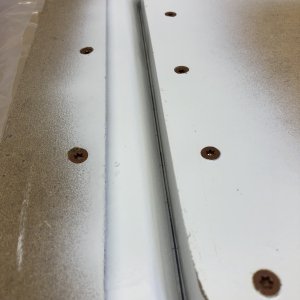
Here's the assembled mold ready to fill with epoxy resin and fiberglass. The molds were constructed from MDF, painted white with three coats of lacquer, and then sealed with six coats of mold release wax.
Here's the assembled mold ready to fill with epoxy resin and fiberglass. The molds were constructed from MDF, painted white with three coats of lacquer, and then sealed with six coats of mold release wax.- pcg
- Media item
- Comments: 0
- Album: Modification- Propane lockers
- Category: Propane lockers
-
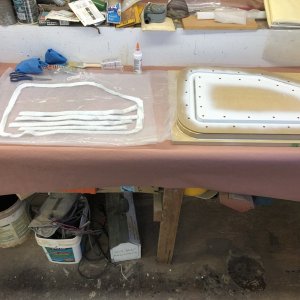
First I made the lid bases. At right of photo I've assembled the four mold parts for the lid base for the starboard locker. On left of photo are strips of 1708 ready to wet out and lay in the mold.
First I made the lid bases. At right of photo I've assembled the four mold parts for the lid base for the starboard locker. On left of photo are strips of 1708 ready to wet out and lay in the mold.- pcg
- Media item
- Comments: 0
- Album: Modification- Propane lockers
- Category: Propane lockers
-
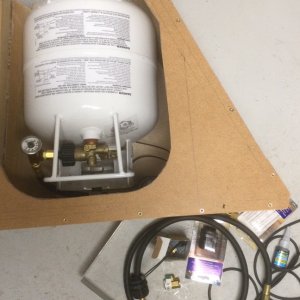
I'm modifying each lazarette to hold a 5 gal. horizontal propane tank. Starboard tank for heater and stove. Port tank for BBQ. Problem: Existing lockers are too small. Solution: Make them bigger. This means not just the interior of the locker, but the opening as well. I also wanted the opening to match the profile of the original hatch opening so, although it will look a little different from the original, it won't look like it wasn't part of the original design. I started with a mockup of the enlarged interior to make sure everything needed to meet ABYC guidelines will fit inside.
I'm modifying each lazarette to hold a 5 gal. horizontal propane tank. Starboard tank for heater and stove. Port tank for BBQ. Problem: Existing lockers are too small. Solution: Make them bigger. This means not just the interior of the locker, but the opening as well. I also wanted the opening...- pcg
- Media item
- Comments: 0
- Album: Modification- Propane lockers
- Category: Propane lockers
-
P
Window washers
Thanks everyone for the great feedback! I've found there are two types of washer sprayers - bulkhead mount and wiper arm mount. I think I prefer bulkhead mount so I can keep the sprayer system separate from the actual wiper system. Also, I've decided not to go with the factory wiper setup from...- pcg
- Post #6
- Forum: Electrical and Wiring
-
P
Window washers
Would they be useful? I'm ordering wiper components for my 22" Cruiser restoration and will be buying the same setup the factory puts in the new models. I have the option of adding window washing capability and the cost is minimal compared to the entire wiper system. There would be a small pump...- pcg
- Thread
- Replies: 5
- Forum: Electrical and Wiring
-
P
something other than wood that holds screws well
I want to imbed (in fiberglass) some stringers that run the length of the floor of my 22' Cruiser, to serve as a level mounting suface to screw down cabinets. Wood holds screws well, but I want somethign that won't rot. I've read here that the plastic lumber at Home Depot holds screws well, but...- pcg
- Thread
- Replies: 8
- Forum: Cabin, Interior
-
P
C-Dory pantograph wiper system
The wipers on my '99 Cruiser are manual. Parts are corroded and need to go, so as part of my restoration I'm installing a powered pantograph system with motors mounted above the windows as found on the newer 22' Cruisers. I'm sharing part numbers and costs and also have some questions. I got the...- pcg
- Thread
- Replies: 0
- Forum: Electrical and Wiring
-
P
C-Dory 22 Cruiser Interior Rebuild
Ron, I looked at your photos and have some questions. The photo entitled "New port side with forward facing seat" shows red upholstery and a bulkhead in front of the forward seat The photo entitled "New V-berth opening" shows green upholstery and the bulkhead to the V-berth removed, but no seat...- pcg
- Post #12
- Forum: Cabin, Interior
-
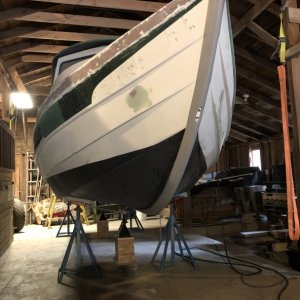
Two layers of Pettit Vivid bottom paint were applied over the primer coats. The original brass keel guard was removed, the screw holes were drilled out and filled with thickened epoxy, then the keel guard was re-installed. The newly applied bottom paint was sanded away where a new 8' KeelGuard would go, and it was installed over the original keel guard.
Two layers of Pettit Vivid bottom paint were applied over the primer coats. The original brass keel guard was removed, the screw holes were drilled out and filled with thickened epoxy, then the keel guard was re-installed. The newly applied bottom paint was sanded away where a new 8' KeelGuard...- pcg
- Media item
- Comments: 0
- Album: Repair - Hull damage
- Category: Hull repair and bottom paint
-
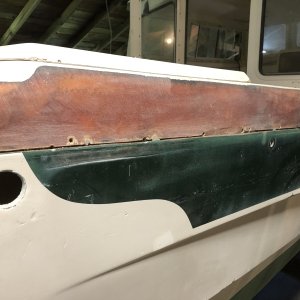
Because the section of the boat above the rubrail had many areas of spider cracking, I just removed all the gelcoat from that part of the boat. In some spots the spider cracking continued into the fiberglass so I removed that as well, and then put new fiberglass over the entire area. I used polyester laminating resin to do all gelcoat repair, which required painting with gelcoat so it would cure. Then sanding off the gelcoat so a final layer of Totalboat epoxy fairing can be applied and sanded down smooth in prepartion for the Alexseal primer coat.
Because the section of the boat above the rubrail had many areas of spider cracking, I just removed all the gelcoat from that part of the boat. In some spots the spider cracking continued into the fiberglass so I removed that as well, and then put new fiberglass over the entire area. I used...- pcg
- Media item
- Comments: 0
- Album: Repair - Rub rail replacement
- Category: Exterior cosmetic repair
-
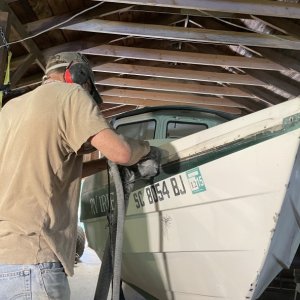
Gelcoat spider crack removal. What a nightmare to repair, or so I thought until I consulted with Andy of Boatworks Today. He convinced me to just abandon the gelcoat and completely sand it off wherever there was spider cracking, put new fiberglass over those areas, and then paint the boat with a high quality marine exterior paint like Alexseal. So the sanding begins...
Gelcoat spider crack removal. What a nightmare to repair, or so I thought until I consulted with Andy of Boatworks Today. He convinced me to just abandon the gelcoat and completely sand it off wherever there was spider cracking, put new fiberglass over those areas, and then paint the boat with a...- pcg
- Media item
- Comments: 0
- Album: Repair - Rub rail replacement
- Category: Exterior cosmetic repair
-
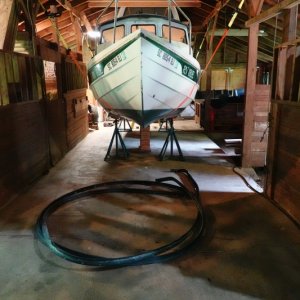
Rub rail removal. That big coil on the ground is the old rub rail. It was still functional, but ugly. It went to the landfill.
Rub rail removal. That big coil on the ground is the old rub rail. It was still functional, but ugly. It went to the landfill.- pcg
- Media item
- Comments: 0
- Album: Repair - Rub rail replacement
- Category: Exterior cosmetic repair
-
Removing the flat spot
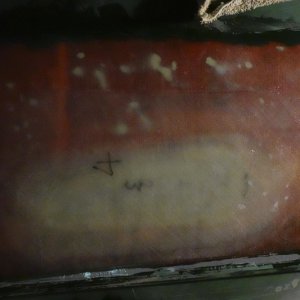
I sanded the paint off the patch and surrounding area and built up the area with epoxy resin and four layers of 1708 until the contour of the patch matched the surrounding area of the hull.- pcg
- Media item
- Comments: 0
- Album: Repair - Hull damage
- Category: Hull repair and bottom paint
-
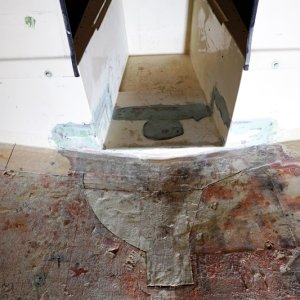
Section of bulkhead has been replaced. The light green substance is fairing compound that was laid over the fiberglass. Next up, lay down a new fiberglass top skin on the cabin floor!
Section of bulkhead has been replaced. The light green substance is fairing compound that was laid over the fiberglass. Next up, lay down a new fiberglass top skin on the cabin floor!- pcg
- Media item
- Comments: 0
- Album: Repair - Hull damage
- Category: Hull repair and bottom paint
-
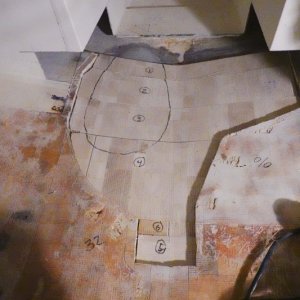
First layer of new balsa core in place.
I used two layers of 3/4" balsa core to match the original 1-1/2" core.- pcg
- Media item
- Comments: 0
- Album: Repair - Hull damage
- Category: Hull repair and bottom paint
-
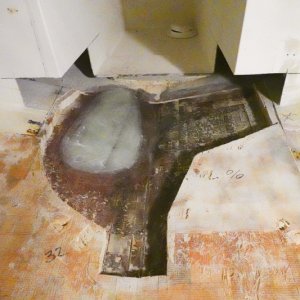
Five more layers of 1708 and epoxy resin and fiberglass repair is finished.
Five more layers of 1708 and epoxy resin and fiberglass repair is finished.- pcg
- Media item
- Comments: 0
- Album: Repair - Hull damage
- Category: Hull repair and bottom paint
-
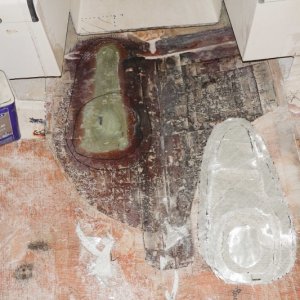
Here I've removed the original fiberglass patch and sanded down to the epoxy layers I laid from the bottom. The area has been painted with epoxy resin in preparation for new layers of fiberglass to go on top. Also note at this point I pulled the entire floor up because I found unacceptably high moisture readings everywhere. The remainder of the balsa core appeared sound and didn't feel wet. After just 24 hours the moisture meter read 0% moisture everywhere.
Here I've removed the original fiberglass patch and sanded down to the epoxy layers I laid from the bottom. The area has been painted with epoxy resin in preparation for new layers of fiberglass to go on top. Also note at this point I pulled the entire floor up because I found unacceptably high...- pcg
- Media item
- Comments: 0
- Album: Repair - Hull damage
- Category: Hull repair and bottom paint
-
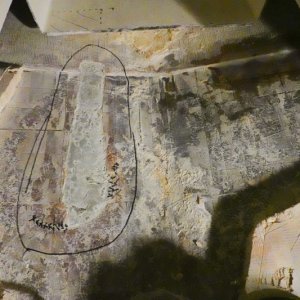
More core and old foam repair have been removed, exposing the original shoddy fiberglass repair, which now has four new layers of fiberglass underneath it.
More core and old foam repair have been removed, exposing the original shoddy fiberglass repair, which now has four new layers of fiberglass underneath it.- pcg
- Media item
- Comments: 0
- Album: Repair - Hull damage
- Category: Hull repair and bottom paint